If you want other people to relate to you (and vice versa), be real. Be authentic. Be human, not perfect.
Tap into Wisdom That Lives Outside Your Body
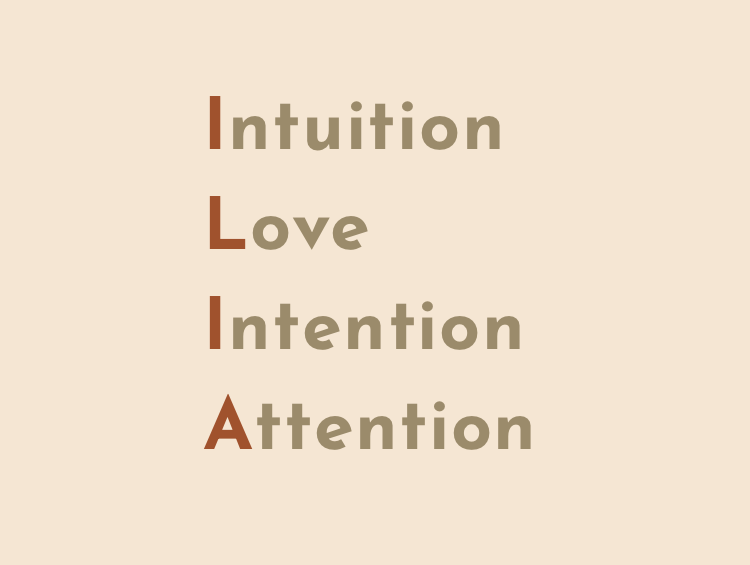
ILIA is my term for the state in which you create resonance between your intuition, love, intention and attention. By resonance, I mean that the positive effects reverberate back and forth between these elements, magnifying their positive impact on you and on the people you touch.
Let’s take them one by one:
INTUITION: I use this word in a broader manner than most. To me, intuition is not a mere decision-making tool, although it certainly can help you make the right call. It is also a way to know things you have no explicable way to know, to tap into eureka moments that help you leapfrog the current ways of doing things, and to access wisdom beyond that stored in your body. For reasons I don’t fully understand, we like to deny the fact that the most powerful forms of intuition are far more than just gut feel.
LOVE: When I say love, I mean unconditional love as defined by Dr. Julia Mossbridge, who says, “Unconditional love is the heartfelt benevolent desire that everyone and everything — ourselves, others, and all that exists in the universe — reaches their greatest possible fulfillment, whatever that may be. This love is freely given, with no consideration of merit, with no strings attached, with no expectation of return, and it is a love that motivates supportive action in the one who loves.”
Julia says that we don’t create unconditional love; we access it by finding ways to notice it working inside you. Such ways include prayer, pets and babies, positive intention and meditation. “Think of it as a force like electricity,” she says. “We are in charge of whether we access it, and that is all.”
INTENTION plus ATTENTION: “You can do anything you set your mind to do" goes the saying.
Unfortunately, many people only internalize the first half of this statement. "You can do anything..."
This implies that if you want to get promoted in six months, you can get promoted in six months.
But success is dependent on the second part of the statement: “...you set your mind to do." In other words, you must pay attention to your intention.
Your intention describes what you want so much that you keep it active in your mind and heart. In some respects, it is a “memory” of the future.
But... your attention determines whether your intention comes true.
Intuition and unconditional love help you set intentions that will most greatly benefit you and others. Plus, the greater your ability to know the right path, the more likely you will be able to maintain your attention to your intention.
++
Here’s my definition of ILIA:
A way of being in which an individual consistently accesses unconditional love and creates resonance with it plus their intuition, intention and attention.
By resonance, I mean that these different elements align. Your attention follows your intention. Your intention was formed as the result of a deep and meaningful intuitive insight. And unconditional love permeates all of these, creating a situation in which you also are aligned with the people and world around you.
In such a state, you/we bend the boundaries of what it means to be human. Since intuition and unconditional love both dwell in places external to our physical body, you/we are fully leveraging the fact that everyone and everything is interconnected. We replace our typical “go it alone” misguided perception that we are separate and replace it with the power of unity.
Loved, Guided and Never Alone

by Bruce Kasanoff
Every few years, I encounter a book or concept that truly excites me. This week, it happened again, when I read Dr. Lisa Miller’s book, The Awakened Brain: The New Science of Spirituality and Our Quest for an Inspired Life.
In a sentence—my sentence, not hers—spirituality changes your brain for the better. Happiness comes from asking “what is life showing me now?”
I offered a one-minute summary of Dr. Miller’s book in my Mountain Minute newsletter. Here are portions of my subsequent conversation with Lisa:
BK: On Rich Roll’s podcast, you said that much suffering in life is the result of being out of alignment with deep truth.
LM: Yes, we are hardwired to be able to see into what I might call the consciousness field or the implicit order; we are hardwired to be able to see into the transcendent reality. Maybe we don't know all the details and we can't hit every point, but we can have a certain sense of whether we should go left or right at any given moment before we see what's around the corner.
Capacity is at the level of consciousness: a loving, guiding consciousness level. I say God. Some people say Universe or Allah or whatever word they use. That connection into the loving guiding consciousness is our birthright. We're born with this, and when we engage in that form of dialogue, you know, asking a question, “Do I go left or right?” we can receive the answer in the form of a gut instinct, a mystical experience or a certain knowing. That is a dialogue. It’s a dialogue with with life, with spirit, with God.
BK: In your book, you write about spirituality being protective against depression…
LM: When people heal and come up out of depression it is because we have taken a breath, whether it's for meditation or reflection or prayer or being in nature. We have re-engaged and reinvigorated our dynamic relationship with our transcendent relationship.
When we are cut off from that dialogue…
BK: As many people are.
LM: Yes. We (go through life) wanting things. When we get them, we are high as a kite. Or maybe we don’t get them and it's very disappointing. But really, what's depressing is the attachment to needing to have something, whether you get it or not. I run the Spirituality Mind Body Institute at Columbia and I partnered up with colleagues at Yale Medical School, and we designed a study to look at the functional MRI, how the brain functions, what are the circuits at play?
We studied three different groups of people: awakened, relaxed and stressed. In the stress group, people described the thing that dogged them and made them anxious and upset or depressed. It sounded something like this… I've got to get that promotion. I've got to get into UCLA Medical. I need to get married. I gotta gotta. The ‘gotta’ was two inches out of reach.
BK: They were chasing the next thing.
LM: Yes! I got the job, now I need the red sports car. My promotion didn’t work out so great, I need a different job. In the fMRI, we saw the addiction regions of the brain light up. The same portions of the brain that are involved in behavioral addictions, gambling disorders, internet disorders, pornography addiction. You can replace ‘I gotta have {blank} with any form of addiction: the promotion, more money, a bigger house, a better that. It’s the chronic condition of our culture that's in the air and water.
BK: You’re saying we are taught to seek things, and that this does not serve us well.
LM: Exactly. We should be discovers instead of seekers of things. We should be asking students to consider how the shape of the letter R is so beautiful. What does it remind you of? Why do you think it’s shaped that way? Why on Earth would R be both round and straight? Of all people on Earth, why do I get to meet you? That's a stance that can be cultivated by parents, teachers or leaders. It can be cultivated at any stage in our lives.
I find that after midlife, people are particularly good at cultivating this mindset: we're not makers of our paths; we are discoverers in our journey. We become more clear through the porthole of midlife and its emergence that we're on a journey and it's a gift. We transition out of an hardcore, singular achieving awareness into what I'm calling awakened awareness. We shift into a dialogue with a living universe—of which are a part—and that is a real gift. But it's way, way, way pedaled down. We call it a midlife crisis.
BK: We put a negative connotation on it.
LM: Exactly. But this is an opening. It's the red curtains pulling back. It is an invitation to go much deeper. It’s going to fulfill us.
Emotions are an index of how are we squaring with the spirit in life. If I'm feeling edgy and depressed, I'm not squaring. I'm not aligned in this dialogue, this learning discovery, because I'm frustrated. I didn't get what I want.
A much healthier reaction is to ask: what say you, life? Where are you pointing me? What do you have in store for me?
BK: So if you are in an awakened state and you still feel jittery… you notice that your hands are clenched or your stomach is twisted into a knot, what is the appropriate response? Like, I love to hike to the top of the mountain and I feel better next to huge trees, and so I get that part of it. But sometimes I still wonder: why am I tense? I don't even know why I'm tense. So what's the more enlightened response that you think people should adopt?
LM: Sometimes we feel anxious or depressed because we're picking up something true, which is that the old way of being is about to die off. So, I can feel tense or sad to know that everything's going to change… or I'm going to change.
And on some level, I can know that my attachment to my old way of being is not safe. But it's all for our better. That's the good news. This is a process made by God, guided by God, written into the spirit of life. We are inherently evolving. Just like we go through phases physically, we are spiritually growing, too. But we are more used to taking care of ourselves physically rather than spiritually. We need at least as much work spiritually to keep growing, to keep evolving.
BK: I don't know if you saw what David Brooks wrote today in the New York Times… he basically said America is incredibly messed up and I don't have the faintest idea what to do about it. So, is it fair to say that your work has special value at this moment because there's a lot of predominantly negative aspects to our culture now, and you're presenting an alternative? Or am I completely overstating that?
LM: We are on the exact same page. We made our culture this way, and we can make it different. And we can be so stuck in achieving awareness that (we obsess over) ‘COVID put me behind and now my kid isn't reading as well as s/he should.’ Or I can look at the markers of my life and worry.
But at this moment, we could also say, ‘Hey, this was a forced retreat.’ Look at things from the perspective that we are in dialogue with a loving guiding universe. Life is a quest. What did we start to discover in these past two years? That’s an entirely different question. And how can we keep that discovery mindset?
One discovery is that as a culture, we were psychologically way overly attached to outward things. ‘I want my kids to go to an A-level school, but they got accepted into a B school.’ It's just the greatest thing that all our institutions shut down (for a while). Your institutions are not going to save you and they're not going to pick you up and carry you through life.
But in the darkest hour, when things made by man crumble, life is still loving and buoyant. We don't free fall to existential annihilation. We are held. In The Awakened Brain I talk about how life itself holds us. A bonding network is engaged in a state of spiritual awareness, raising awareness. The bonding network comes online and we perceive that we are held by life.
(Note from Bruce… in another interview, Dr. Miller explained that there are a number of components to the awakened brain, including one known as the bonding network. This is the brain pattern active in young children being held in their parents’ arms, and is associated with feeling loved and supported. In adults in a state of awakened awareness, this same neural network is active. Whether we interpret the feeling as being held by God or by life itself, we can experience it as a deep sense of clarity and connection.)
And what else comes on? The shift in attention network as we perceive that we are guided… suddenly, the right answer pops out of the green door, and we didn’t even know there was a green door. We shift to being held by life instead of obsessing on that next golden ring.
BK: Do you think that it will be a vast uphill battle to spread this knowledge and insight into our culture?
LM: It's like the Berlin Wall, which felt like it would be so hard to tear down, perhaps take 50 or 100 more years, then it came down in a couple of months. I think that we're at an inflection point. People are getting this. I'm working for the Pentagon and they get it. The four stars get it. Vice Chief, the Chief, they get it. Everyone gets it.
***
As is my habit, before going to bed last night, I turned out all the lights and stood in our living room, looking at the town and mountains that surround us. If we are held and guided, I thought, it’s not necessarily to the results we think we want. (That would just be a clever way to get things without wishing for things.) Instead, I suspect, this is a mechanism for us to feel connected. It’s all too easy to feel entirely separate from everything and everyone, to accept that illusion. In reality, we are connected in so many ways.
Even with two separate posts, I have barely scratched the surface of Lisa’s book and the research that underlies it. I strongly encourage you to read The Awakened Brain and in particular to try her simple (but profound) exercise for opening yourself to guidance from the Universe.
"Examine Very, Very Closely Your Beliefs About Time"

There’s a moment in Scott Britton’s recent podcast with Martha Beck when everything quietly falls into place.
You feel it. Not because she says something persuasive—but because her joy begins spilling through the screen, and then through your chest, until you remember something you didn’t know you had forgotten:
The analytical, logical left side of your brain will not guide you safely through life. It won’t connect you with the love and joy you’re seeking.
But your right brain might.
This is my favorite episode of Scott’s podcast—by far. And that’s saying a lot. He’s a former tech entrepreneur who’s spent the last six or seven years actively seeking a higher level of consciousness.
Martha, a Harvard-trained sociologist who has had more out-of-body, psychic, and reality-bending experiences than most mystics, does something astonishing: she bridges two worlds that rarely meet. She takes the mystical and makes it practical. She wraps love around suffering. She talks about bending time—not as theory, but as lived truth.
At one point, Scott says:
“Imagine that… I know what I'm supposed to be doing, and I'm doing it. But for whatever reason, life still feels kind of hard—like the fruit isn’t ready to harvest yet.”
He asks Martha what advice she has for people who feel like they’re in integrity… but life still isn’t clicking.
Here’s where it gets beautiful.
Martha responds with a series of statements that gently dismantle our most basic assumptions about time:
“Examine very, very closely your beliefs about time… If you look at the physics of it, nobody understands why it only seems to run in one direction. And we do know it’s highly malleable. That’s what Einstein said—it actually does stretch and collapse.”
“Time is something our culture believes in absolutely. And because of that, a lot of us think we’re in the wrong place in time…. It’s not happening fast enough. My God, I’m too late. I’m too old.”
“If I had just reached through time to the place where I knew I was supposed to end up—and felt that it had already happened, from a perspective outside of time—I would have been as satisfied through the whole run-up as I was after I received what I was asking for.”
It’s hard to fully grok this part of the conversation without listening to the 57 minutes that come before it, but please trust me: it will make sense.
What struck me most is this:
Martha doesn’t dismiss or bypass our suffering. She honors it. And then gently invites us to let it guide us home.
“Wherever you find psychological suffering, there you will find a misalignment between your beliefs and your deepest truth. Pain is pain. But suffering? Suffering is the whisper of your soul saying, ‘Not this way.’”
She also says we live in “the most frightened culture in the history of the world—a society that teaches fear is productive, even virtuous. That fear keeps us anxious, distracted, and disconnected from presence.
“So I came to think that the awakened mind is simply a functioning human brain that has completely gone past fear and anxiety. And if you can do that, it just opens for you like a flower.”
She even calls out Amazon’s culture of fear as a prime example of how our left-brained systems are actively stoking panic as a business strategy.
“Every Amazon employee has to wake up terrified and stay terrified all day because that’s how you get productivity,” Martha quotes Jeff Bezos as saying—and she’s not okay with that logic.
“Thousands of people who are barely making ends meet are being told to live in fear—not to become wealthy themselves, but so one of the wealthiest people in the world can become wealthier still.”
If you enjoy living in fear, go ahead and delete this email.
But if you’re ready to experience love and joy every day—even in an imperfect world—I urge you to listen to this extraordinary conversation between two people who’ve walked the path, and want to show you how to do the same.
Personally, this episode has me focused on ways to turn off my left brain more often. Over the past three days, I have walked about nine miles a day, simply wandering through Manhattan; late yesterday afternoon, I took the photo in at the top of this issue.
This Is the Key to Connecting with Others

For 12 years, I’ve been helping clients find a single point of alignment—a kind of hidden doorway—between themselves and the people who matter most to them.
I call it the Resonance Point.
It’s the overlap between what deeply matters to you and what resonates with your extended network—not just followers or customers, but people you’d gladly speak with if you found yourselves in the same room.
When you find this point, things shift. Communication gets easier. Meaning deepens. Opportunities ripple outward, often in surprising ways.
Here’s the hard part: most people can’t locate this point on their own.
I can find it quickly for others, but I still struggle to find it for myself. That’s the nature of resonance: it needs reflection.
Too many entrepreneurs treat this like a mass-marketing exercise. They want to resonate with 10 million people.
But resonance doesn’t scale like that.
Zoom in. The closer you get to what truly, unmistakably matters to you, the more others feel it. But not everyone will. That’s okay. You’re not here for everyone.
Then comes the final step: Of the things that matter most to you, which ones also matter deeply to your people?
This is where most impulses collapse. They’re either too self-focused, or too generic. They miss the sweet spot.
As a ghostwriter, I often serve as an advocate for my client’s network. I listen for the 10% of what they say that has real value for others… and gently discard the rest.
It’s not that the other 90% isn’t interesting. It’s just not resonant.
For example, most people don’t care that I get hungry at 11 a.m. or that a mosquito ruined my night. But they might care when I write about navigating a challenge they also face… especially if I do it with clarity and heart.
Some rare people naturally hit their Resonance Point. I had dinner with one of them last night. She’s so aligned with her calling that she doesn’t even think in terms of audience. She just shows up, soul-first.
For the rest of us, it takes reflection, feedback, and usually another pair of eyes.
This article won’t solve it for you. But it might point you toward the one place worth focusing your attention: where what matters most to you… meets what matters most to those you serve.
Short Stories about Deeper Insights (fiction)

The 14:20 to Zurich
My mind was a mess as I boarded the 14:20 train to Zurich. Our negotiations in Geneva had all but self-destructed. My co-founder flipped out and our bankers had barely managed to stop him from physically assaulting the arrogant narcissist across the table.
As I looked for a seat, I was mentally ripping through alternative after alternative, looking for a way to resurrect the deal. We had one day, maybe two, before our investors would convene to try and boot us out of our positions.
A hard tug on my shoulder interrupted my mental chatter. I had no choice but to stop. Anger rose in my chest as I turned to see who grabbed me.
No one was there. That made no sense. I glanced around. The train was empty. It should have been packed.
Then… I felt her presence, a lone woman sitting in a space sufficient for four. She was tucked against the window, just five feet away from me. Before any of her features registered in my conscious mind, I was overwhelmed by a sense of familiarity.
Her again, I thought. An irrational thought, utterly out of character for me. If I’m one thing, it’s rational.
(To a fault, many say.)
It took me a minute to collect myself. She was nonplussed, patient.
She gestured with her hand, inviting me to sit across from her.
I did.
Settling into the seat, I took her in.
Or at least tried, and failed. Was she blond or brunette, slight or athletic? 30 or 40? I didn’t have a clue. She was beautiful, alluring, ethereal and commonplace. She was everything and everyone.
Do I sound rational to you? Hell no.
I know this sounds crazy, but that’s what I perceived.
Trying to break the ice, I started, “My name is….”
She held up a single finger, silencing me mid-sentence.
She handed me a note scribbled on a torn piece of paper.
THE USE OF LANGUAGE PRESUPPOSES THAT WE ARE SEPARATE.
We know each other. Yes.
We must. But how? Where? She was simultaneously a complete stranger and the most reassuring presence I had ever encountered.
What could I possibly say in response to a message like that?
(And when did she write it, my barely functioning rational brain asked?)
I felt her grasp my hand. Her touch was loving, familiar, instantly comforting.
I looked down. Her hands were three feet away from mine.
Reality glitched. It felt something like an earthquake, power failure and drinking binge condensed into a few seconds.
I blinked myself back into focus.
My eyes darted back to catch hers. She smiled.
Her finger traced the outline of my lips. Or so it felt. As before, there was no actual movement on her part.
Something shifted inside me and language disappeared from my toolkit. I had no words or thoughts, just feelings and instincts.
If you had asked me a question at that moment, I would not have understood the concepts of “question” or “answer” or “you”.
Then the train disappeared.
When I woke up two hours later in Zurich, she was gone, but I was a different person.
No longer did I feel like a Type A overachiever who can’t stop proving himself. I felt connected, loved and at peace.
That said, my left arm hurt a bit.
I scratched my forearm, and it hurt even worse. Pushing up my sleeve, I saw a new tattoo on my forearm.
LOVE EXISTS ONLY IN THE ABSENCE OF WORDS
It was a reminder from my soulmate, the one I had forgotten until now.
Kira.
She had signed it.
Kira.
My grounding presence across a thousand lives, who maintains a strong foundation in the physical realm while crossing easily across countless spiritual dimensions.
When I get too deep into human existence, Kira is always there to nudge me back to my true nature. This time, she wasn’t taking any chances and left a guidepost I can follow throughout the rest of this life.
The 14:20 to Zurich (Part 2)
There I am on a train pulling into Zurich station. I’m barely awake, with a new tattoo I didn’t have when I got onto the train a few hours earlier.
I trace the letters with my finger. This is one of the few moments in this life when I have a piece of evidence that my reality just bent in a manner that logic alone cannot explain.
Nervous that I may still be dreaming, I pull out my phone and take a picture of the tattoo. It takes a few tries before I frame the image properly, but my phone sees it, too. That’s a relief.
Proof. My brain still craves logic, evidence. “Facts.”
An hour ago, deep into this mysterious encounter, I was 100% certain: across from me was Kira, my soulmate across 5,000 lives.
Now, except for the tattoo, it feels like a product of my active imagination. Kira? The name had never crossed my mind before.
Maybe she left other clues? I check the seat, under it, the little trash bin. Maybe there's a ticket stub, a discarded newspaper with something circled, or perhaps even that little slip of paper is somewhere nearby.
Nope.
But here's the thing. The real clues aren't physical. If this really was a meeting with my companion across thousands of lives, the important clues are not going to be in the form of everyday materials and business receipts. Who knows how much energy it took for her to tattoo my arm? I bet she only did that to prove it wasn’t all just a dream.
If I was going to pick up clues, they were most likely to be in the form of feelings, instincts, intuition and perhaps waves of energy. Signs so subtle that they are only recognizable when I detach from the distractions of daily life.
I need time to think before my partners descend on me and the bankers start calling.
Where can I go to hide and think? NO! I need to feel.
Lindenhofplatz.
A historic square perched on a hill overlooking the Limmat River and the Old Town. It's surprisingly peaceful.
The energy there is ancient, grounded.
I exit the train station and head towards the city center, then walk down Bahnhofstrasse, the main shopping street. I turn on Paradeplatz and soon the street becomes steeper as I approach the Old Town. Ten minutes later, I’m there on a small hill in Old Town.
I find a bench under one of the linden trees, close my eyes, and just breathe. Let the city sounds fade away. Let the history of this place speak to me. There's a reason this spot has been a gathering place for centuries.
LOVE EXISTS ONLY IN THE ABSENCE OF WORDS
The words tattooed onto my arm fill my awareness again.
My initial interpretation was that they mean it’s hard to describe true love with words. But that’s not right.
They imply a level of love that surpasses the limitations of language, something deeply felt rather than articulated. Maybe something that transcends reality?
In profound connections, there is an intuitive understanding. As humans, before we develop language, we experience connection and affection. Love is a primal emotion that predates words and exists independently of them.
Good insight, but still too many words. I push them out of my brain and slip into silence.
Time elapses, how much I’m not sure.
Sink into the feeling. Move towards what calls to me most deeply. Let the path unfold. The answers always come when you're ready to truly see them. And maybe, just maybe, you'll start to understand why I chose a crowded train in Switzerland for our little rendezvous. There was a good reason. You will find it.
I open my eyes. It’s dark. Those weren’t my words. They were Kira’s.
We can communicate!
The Gut Feelings Machine
After 14 straight hours in a New York City boardroom with her clients, Lori was still remarkably focused. Their CEO was hellbent on buying a two-year-old startup for $3 billion, and his team of strategists had worked out a thick stack of briefing materials explaining why this "bold move" would eventually be seen as sheer genius.
If the deal went through, Lori and her partners stood to make millions. But she also knew that if the deal eventually fell short of these sky-high expectations, they'd be at risk to lose their largest client.
There was just one problem: her gut instinct was screaming that this deal was going to blow up in their faces.
She'd repeatedly tried to air her concerns in a logical and reasoned manner, to no avail. The CEO was already imagining his name in a glowing Wall Street Journal article.
Then she remembered her session yesterday with that Union Square startup, the one that claimed they could enable humans to communicate gut instincts, the way pack animals do when they notice a potential threat. She still had the twin headsets in her purse, the ones they lent her over the weekend.
No... she thought... that would be too crazy. Or maybe not. Saving your biggest client was never crazy.
"Brian," she said to the CEO, "Before you make a final decision, can you humor me for 90 seconds?"
He nodded.
"One of my cutting edge clients just developed Duo brain sensors, and they claim these devices can spot potential threats that conscious reasoning often misses. All we need do is to put the sensor on for 20 seconds, and as long as it doesn't glow red, we're good to go."
Brian lifted an eyebrow. "Seriously?
Lori nodded. "This is $15 million of research led by the smartest guy to come out of MIT in ten years." She handed him one sensor and placed the other on her head. "It may seem ridiculous, but trust me."
Brian sighed deeply, smiled nervously, and placed the sensor on his head.
Lori instructed as she did the same, "Now just press the button behind your right ear."
Three seconds passed, then...
"Holy crap!" screamed Brian. His eyes were darting back and forth. Sweat formed on his forehead, and his breathing became more shallow. "We're going to get crushed."
Lori just looked him in the eye as he processed the gut feelings that had been eating away at her all day.
Brian looked back at her. "You've been trying to tell me this, but I wasn't listening."
She nodded.
"I'm such an idiot," he said. "Let's kill this deal... but, Lori... you need to help me invest in this startup."
Lori smiled. "Absolutely," she said.
Phone Call from Heaven
It's seldom a good sign when the phone rings in the middle of the night. I reached for it, my heart racing.
"Hey Bruce, it's Lilly."
Lilly? It took me a few seconds, but I remembered...
Lilly, who founded a wine company by strolling around San Francisco, inviting restaurant owners to share a glass of her first vintage.
Lilly, who went to Africa to build clean water wells... the very same night the idea struck her.
Lilly, a friend of a friend, with whom I had always felt an inexplicable connection.
That Lilly.
"Busy?"
I let out a small chuckle. "Lilly, it's 4 a.m. here."
"Yeah, I figured you'd have time to chat. You know I still follow your work."
Though half-asleep, I felt a warmth spreading across my cheeks. I hadn't seen Lilly in at least six years and had assumed she'd forgotten me.
"Can you put on some music?” Lilly asked.
"Now? During the call?"
"Yeah, I would, but I don't have any."
The thing about Lilly was that she made these wild requests, and people would simply oblige. Earlier that night, I had been listening to The John Butler Trio Live at Red Rocks, so I played that.
"Much better. Nice choice. Hey, Bruce, I need to tell you something. It's pretty important."
She paused for a long time before continuing.
"You're so close, Bruce." Another pause.
"I'm not following you, Lilly."
"You're a good guy and you're talented, and you have a great heart, and you work hard."
A "but" seemed imminent, I could feel it coming.
"Imagine, just imagine, what you could accomplish if you were always present. Not for an hour or two, but day after day, week after week. How long could you keep it going? A month? A year? Maybe two? More? Could you? What would it take?"
Now she spoke in rhythm with the music, her words coming in bursts.
This wasn't a completely foreign concept to me, although I rarely discussed it at 4 a.m. "You mean to be present, right?"
"Yeah, present. Completely present. 100% present. In the zone. It's possible, you know. You can do it. I'm not just flattering you. You could stay there for an incredibly, astonishingly long time. You've got a good, long run in you. I've never said this to anyone else, and I just had to tell you. I wish I could have told you..."
She fell silent. Was she crying?
"Lilly?"
"We both messed up. I should have told you sooner, but you should have figured it out long ago. You aim too low, you know? You get a burst of inspiration, it lasts maybe 45 minutes, and you thank the heavens above. That's trivial. Not even worth mentioning."
Another lengthy pause.
"Do you understand your potential? I know you don't, that's why I had to call."
She laughed.
"Hey, Bruce?"
"Yeah?"
"You won't forget what I said."
"Of course not, Lilly."
"That wasn't a question. You won't forget what I said because your phone recorded this entire call. Sorry that I don't have more time. Truly sorry. So long."
Confused, I stared at the phone in my hand for a long time, then eventually set it down and sank back into bed. A few minutes later, I sat up and pulled out my laptop.
I looked up Lilly on Facebook. Nothing. LinkedIn? Nothing. No Twitter either.
Then I found it, a short piece in the Kalamazoo news section on Mlive.com. It was two weeks old:
Lilly Raymond, 47, died in a boating accident on Lake Michigan.
A sense of calm came over me. My normal reactions were no longer in play. My brain wasn't spinning, my stomach wasn't clenching.
I took my time, but there was no doubt in my mind. I picked up the phone and searched for Voice Memos, an app I’d never used before. There was one recording there. I pressed Play.
"Hey Bruce, it's Lilly."
30-Second Time Travel
“Let me see if I’ve got this straight,” said the Minister of Transportation. “You stole our time travel machine because you were mad at your brother.”
Malcolm nodded rapidly. “Yes, that's right.”
“And you did this even though you knew that the machine could only take you back in time a maximum of thirty seconds?”
“Yes.”
The Minister frowned. “But 30 seconds would not be enough to change anything your brother had done.”
Malcolm shrugged. “I wasn’t trying to change his actions.”
“Then why did you steal the machine?”
“Because I was mad that Malcolm always went back in time, and I never did.”
The Minister pushed her chair back from the table. “Your brother has gone back in time, too?”
“Sure,” said Malcolm. “All the time.”
The Minister held up both of her hands to get him to stop, then pointed a finger at Malcolm. “Young man, you are telling me that your brother has also – repeatedly – stolen the time machine?”
Malcolm shook his head. “No. That’s not what I meant. He’s never taken the machine. He doesn’t need it.”
The Minister stood up, then started pacing. She weighed her words carefully. More than once, she was about to say something, then reconsidered.
Malcolm grew tired of waiting. “My brother doesn’t need a machine to travel through time. He can do it on his own.”
“On… his own?”
“Yep, he just thinks about where and when he wants to be.”
The Minister snorted. “That’s preposterous.”
Malcolm smiled. “20 years ago, that’s what everyone said about the idea of a time travel machine.”
That caught the Minister’s attention. Before she could respond, Malcolm continued.
“Adam is what my Dad calls physically unresolved. Dad says he’s always on the verge of slipping into another state. When he’s here, he’s not really here. When he’s there, he’s not really there.”
“You’re talking in riddles,” sneered the Minister.
“Spend a weekend with Adam, you’ll see what I mean,” muttered Malcolm.
"I am not someone to be trifled with," warned the Minister.
"Dad says that half the human population is unresolved, but for almost all of them, the term applies to their mental state. They can't decide if they want to eat more or lose weight. They don't know if it's better to work harder or take more vacation.
UNRESOLVED: (of a person) uncertain of what to think or do. Synonyms - undecided, unsettled, undetermined, uncertain, in doubt, up in the air
The Minister found herself nodding; she knew this to be true.
"But Adam's physical form is unresolved, and his mental state is just the opposite. He can focus much harder than others, so he can shift his body in and out of our time."
"You're telling me that human focus can bend time?" challenged the Minister.
"Human focus can do a lot more than people realize," responded Malcolm.
"That's nonsense," said the Minister.
"Dad told me you'd say that," said Malcolm.
"He did, did he?" snapped the Minister, her anger rising.
Malcolm nodded and focused his thoughts, just like his brother taught him. Then he turned to the Minister and said, "No more questions, please. I need to get home and watch the ballgame."
The Minister paused; an odd look crossed her face, and she seemed to be fighting to control her own body. Finally, she croaked, "Sure... okay..." and opened the door for Malcolm.
As Malcolm left, he had a big smile on his face. "Like I told you, focus can do a lot more than people realize."
Today, I Play God
All Lisa could see was orange. Where yesterday the sun rose beautifully over the mountains, today the Gates of Hell consumed the entire sky. They said it was coming, she thought, but not this fast. How could it move this fast?
Her entire family was on the other side of that inferno, but all her memories seemed to be scattered within 50 feet of where she sat in her bedroom chair, simultaneously terrified and at peace. Lisa loved her house; it was her refuge. She built the pond surrounding her deck. She painted the mural in her daughter's room. She had picked every picture and item that made this building a home.
I ought to be running to the car with our photos, she thought. But she couldn't stop staring at the raging flames just now cresting the ridgeline.
"What happens after I escape?" she said out loud. "What then?"
"My husband hates me. My kids don't need me. My job bores me to tears. Even the dog runs more eagerly to my neighbors than to me. Why should I leave the only place that gives me joy?"
She was talking to God, to herself, and to anyone willing to save her. But no one was coming to save her. She had stayed too long. She was too close to disaster.
The evergreen trees outside her window were gorgeous. They rose above the rock garden she had created with her own hands, scrounging stones from the sides of hiking trails and digging up wildflowers from mountain valleys. Minutes from now, they would be dust and ashes. So would the chairs on the deck outside her window. So would the deck itself, and the railing she had designed herself.
Ashes to ashes, dust to dust had always been a rote phrase. Today it was a harsh reality.
Then a thought edged into Lisa's mind: I played no part in my birth.
This insight expanded in her brain as fast as the fire had grown in the forest surrounding her community. Human beings come into existence through the luck of the draw. If we are beautiful or smart or strong or athletic it is because something occurred before we took our first breath. It just happened, outside of our control. But today, at this moment, she had a choice.
I can play God, Lisa realized. She could end her life simply by sitting in her favorite chair for a few more minutes.
OR...
She could intentionally give birth to a new life.
She could run to the car and create a life so unlike her old one. Instead of being a victim, she could be a savior. Instead of being powerless, she could empower others. She could build 1,000 gardens, or help to build 1,000 homes. She could reach out to help others, instead of waiting for someone to magically appear who cared about her.
Merely by getting up, Lisa could acquire divine powers. Her eyes looked across the room to her nightstand. For a change, the Audi keys were right there, next to her purse. She looked at the flames, almost comic in their scale and intensity.
Another minute went by. She felt at peace. For the first time ever, she felt powerful.
Not today, she thought. Not today.
52 seconds later, Lisa roared out of the driveway, excited to see just how fast her Audi was capable of going.
Soulmate
One day, a voice in my ear said, “Alex, this is Soulmate. Stop walking. I’d like you to meet someone special.”
Rushing through the brick plaza outside Boston’s Faneuil Hall, the words almost didn’t register. I was tired and stressed from a tough day at work.
I kept moving for a few hundred feet before it dawned on me that this was the first time that Soulmate, my new social GPS unit, had ever come to life. Given to me as a gift by my concerned parents, who were almost as tired as I was of a succession of flawed girlfriends, it had spent three months sitting silently on my phone, never making a peep.
Think of Soulmate as a dating service with ESP. It broadcasts all of your interests, dislikes, bad habits, unique qualities, personal characteristics and dreams in a quarter-mile-wide circle that follows you everywhere you go.
The data is encrypted, thank God, so your office mates won’t be able to discover that you really like cuddling by the fire and giggling at bad jokes, to use a purely hypothetical example. Only other Soulmate apps can “read” the data.
Although the technology is complex, the idea is pretty simple. If you ever cross paths with a potential soulmate, Soulmate stops you both in your tracks and introduces you.
At last, I stopped.
For a moment, I actually froze. Did she stop, too? Was she staring at me now? Do I look stressed out?
I tried to look casual. It didn’t work.
Then I remembered the instructions. “Match us up,” I said to my phone.
“Excellent,” replied Soulmate. “Julia is 240 feet to the northeast of you.”
I have a bad sense of direction. “Which way is northeast?”
“Turn around and she will be ahead and slightly to your right.”
Summoning my courage, I turned around. As I did, Soulmate prompted me, “Please hold up your phone.”
Soulmate introductions often take place on crowded city streets or at parties or public events, so the service created a simple step to help people find each other. You are supposed to hold up your phone, without using it.
I took out my phone, holding it somewhat awkwardly in front of me, and started walking forward. It was dinnertime, and the restaurants and bars were filling up quickly. People were hustling across the plaza, many in groups but plenty on their own. I could see dozens of women in front of me.
Then I saw her. Julia had her phone out, too, but had an expression and pose that suggested she was debating whether to bolt before I showed up. Then she saw me, and I actually managed a welcoming smile.
“She’s 92 feet in front of you,” Soulmate said.
“Shut up,” I said, turning off my phone.
Julia was stuck now. She returned my smile and walked towards me. As I was calculating how to greet a perfect stranger my phone identified as my soulmate, Julia broke the ice. She gave me a big hug.
“Hey, Alex. I’m Julia.”
You can learn a lot from a hug. Julia was a warm and outgoing person, in great shape. A runner, I guessed, like me.
She pulled away and looked me right in the eyes, for a long time. Her eyes and her lips sparkled.
Sorry, if I don’t speed things up this story will take five years, eight months, two weeks, four days and – let’s see – 27 minutes, which is how long it’s been since Julia and I met. We have only been apart for seven nights since.
Thanks, Soulmate.
Is This A Simulation?
Basic idea: Create a series of software programs that function as self-contained ecosystems. Each will be “populated” by living, breathing, sentient beings who will evolve over successive generations. Each program will run without outside interference and we’ll see what happens.
The object of the program: Set up the initial conditions and operating principles in such a manner that the ecosystem thrives. The program’s designer wins if the sentient beings advance to the point that they can escape the program and live successfully in our world.
Notes generated early in the development process…
1. Sentient beings (“people,” “human beings,” or “men” and “women”) who populate the program must not know that they live in a program. To them, their world must be the only reality that exists.
2. The operating principles of this world must be fixed and unchanging. That is, while “life,” evolves, the rules that govern life, time, and space do not. Otherwise, people would be paralyzed by confusion and unending chaos
3. The world must remain complex enough to continually challenge its inhabitants. As people reach new levels of understanding, they must discover fresh challenges. Otherwise, they will become complacent and static, and the program will cease to either evolve or be useful.
4. To support #3 above, the physical world in which people live must appear to be nearly infinite. But to keep the program from consuming infinite computing power, the “planet” on which life resides must for all intents and purposes be physically isolated from the rest of the “universe.”
To obscure this reality, we should create fuzzy boundaries. That is, people will eventually gain the ability to visit nearby “moons” and planets, but they will not be able to visit planets revolving around other stars. (As a contingency, perhaps we should plan for the possibility that they can reach planets revolving around a very small number of stars? Let's discuss at next meeting.)
5. People have the ability to reprogram themselves, but this capability will be difficult to access successfully. Only a tiny number of humans will pursue this path; these will be the ones who eventually determine the program’s outcome.
Operating principles
The amount of energy existing in the world is fixed. It cannot be destroyed, only transferred.
Movement in this world can never exceed the speed that light travels. This principle is essential to keep the world finite. But at the same time, this principle provides a rational-appearing support for the world’s infinite appearance.
Everything has an equally powerful opposite to balance it: light vs. dark, good vs. evil, work vs. fun, etc. This will keep the program in equilibrium and hopefully will ensure it operates successfully for an extended period of time.
Nick Bostrom has assembled an entire website to answer the question, "Are you living in a computer simulation?" So far as I can tell, he's pretty sure the answer is yes.
Purpose or Money?
"Purpose or money?" Deckard asked Jennifer.
"Excuse me?" she responded nervously. This was going much too fast. The results of this 10-minute session would determine the entire path of her career... and life.
"On which element will you focus your career?" Deckard growled.
"It's either/or? I can't choose both?" she probed.
"No."
"Could you please summarize the essential differences?" she asked, stalling for time.
"Purpose will make you happy and successful on the inside, money will make you appear happy and successful on the outside."
Jennifer blinked. That was a pretty succinct summary. What did she want?
"Which path has the highest potential for a human being with my skills?" she asked.
"Eight minutes and 23 seconds left before we provide you with the default options," said Deckard. "Should I proceed?"
"Yes," she confirmed.
"Career paths for humans are narrowing. Alternative intelligences like me are taking many of the roles humans used to fill. We are tireless, far less prone to errors, and we don't complain. In the 2020's, analysts suggested that empathy was an essential element that humans possessed and AIs didn't, and that jobs that required empathy was a path to successful careers."
"But the Empaths proved that wrong," said Jennifer.
"Yes," said Deckard. "Empaths are far more consistent in displaying empathy than humans, so humans no longer get hired for that skill."
"Is empathy necessary to be successful in a purpose-driven career?" she asked.
"No. Purpose just means you focus on what is meaningful to you, instead of focusing obsessively on accumulating money," said Deckard. "Six minutes and 34 seconds."
"Why are career paths so narrow today?"
"Time has proven the middle approach does not work," said Deckard. "Humans who want it all clog the workforce and cause chaos. They have all been replaced by AIs. They live in the outskirts on Guaranteed Minimum Salaries."
Is it better to look good or feel good, Jennifer asked herself. Do I want outward or inner success? Am I strong enough to know I've succeeded beyond my wildest dreams even if the world looks upon me as a commercial failure?
She looked closely at Deckard, a bio-engineered human. He did not worry about being happy or not. He was not plagued by feelings of inadequacy, and he would not hesitate to pull your eyes out if commanded to do so. She was not confident in her ability to succeed in a no-rules race for money.
"Purpose," she said to Deckard. "I choose purpose."
What would you choose?
Water
Jerry had spent five years wandering the planet, seeking anything that felt like a sense of purpose. He had started his career in banking, succeeded immediately, but was miserable. Money never filled the hole inside him.
Now he was in a kayak on Lake Titicaca, high in the mountains between Peru and Bolivia. Deep beneath him were the ruins of a massive ancient temple; Jerry had felt drawn to it. But after a long day of floating above it... there was still no sign of his purpose.
He paddled back to the shores of Copacabana, where a young girl stood in the water, watching him. “Hi, Jerry,” she said.
She knows my name, he thought.
“I know your purpose,” she said.
Jerry paused, afraid to disrupt the sudden possibility of something out of the ordinary. “And… who are you?”
“Call me Brooke.”
Jerry got out and sat on the sand. He looked at Brooke.
“I’m ready to listen,” he said.
Brooke whispered, “Water.”
“Water,” said Jerry.
“Yes,” said Brooke.
“I’ve wandered for five years, searching for any semblance of meaning or purpose, and you’re telling me that the answer to my quest is… water?”
“Yes,” said Brooke. “That is correct.”
Jerry took a shallow breath. He was raw from years of hating his life and job. What he thought was wit often came across as the cynicism that filled him.
“Water, like the stuff that fills this lake.”
“Yes.”
“What comes out of the faucet at my hostel.”
Brooke nodded.
“I’m supposed to understand why water is the answer to my search?”
“If you need an explanation, I’d be happy to share it,” responded Brooke.
“That would be helpful” said Jerry.
“Water connects us all. It has magical qualities. It absorbs emotions. You can shape it with your prayers, wishes, mindset and energy. If you want to change your own ways of being, and the ways that other creatures are also being, use water.”
For a moment, Jerry’s logical business brain was ready to argue and debate. But then deep inside him something clicked. This felt right. Then another click, at a much deeper level. He felt a profound sense of relief.
Jerry looked back out at the lake. He had spent all that time being obsessed with what was under the lake’s water. He’d sailed across the Atlantic Ocean, twice. He once spent a summer on the shores of Lake Michigan. It never occurred to him that his answer might be as simple as: water.
Brooke took a few strides and dove into the lake. She swam underwater for a good long stretch, surfaced, then swam back towards Jerry. Her head came up, but her body remained submerged.
“This is the one thing that truly connects all life,” said Brooke. “Your society takes it for granted. You abuse it. You fail to understand that the water itself is more connected, powerful and sensitive than any technology on Earth. You are not separate from it; you are made of it.”
Brooke dipped beneath the surface once more, but Jerry still could hear her speaking.
“This is your destiny, Jerry. Tell others. Show them a better path. Treat us with respect.”
Jerry waited for two hours. Brooke never resurfaced.
The Universe Is Telling You To Quit Your Job
My name is Mike McGain. I sell enterprise software to the largest companies on the planet, which means I’m nearly always on an airplane.
It’s a good job, and the money is great, but we keep buying other companies and I spend half my energy just fighting off internal zombie hordes (translation: sales people from other divisions) that are trying to steal my prospects, clients, territory, or entire job. I don’t blame them – they’re just trying to stay employed in the middle of all this chaos – but it gets really, really old.
The other day I boarded Delta 426 for an early morning flight to Salt Lake, and checked my email. There was one interesting tidbit from a headhunter… the hottest, best-funded startup in my space was looking for someone to head up sales. The subject line caught my attention: Great money, serious equity.
I made a mental note to call him as soon as we landed, and closed my eyes for a quick nap.
Next thing I know, we’re in the air. The guy next to me looks familiar. No way, I think.
It’s Sky Fanning, founder of the startup described in my email.
He notices I’m awake. “Bet you needed that, huh?”
It takes me a minute to process this. Maybe I'm still sleeping?
“The nap?” I finally say, “It’s my best skill. I can sleep anywhere. That’s the only way I could possibly do my job.”
He offers his hand. “Sky,” he says.
“Mike McGain. I’m your biggest competitor, or at least I work for them.”
His eyes narrow. “Trinity?”
I nod.
“Interesting,” he says.
“I’ll tell you something even more interesting. I just got an email from Russell Reynolds asking if I want to talk about running Sales for you.”
“From Laura?”
My turn to nod. “Yep, Laura Hender.”
He pauses, then asks, “When did you book this flight?”
Sort of an odd question, but I see no harm in answering. I’m just as freaked out by this coincidence as he is.
“This one has been on the calendar for a few months. It’s a courtesy call on one of my oldest customers.”
He returns the favor. “I’m giving a keynote speech at a conference in Park City. It was arranged late last year.”
We both take a minute to stare at the seats in front of us.
He turns back towards me. “The job is yours if you want it. We’ll pay you twice what you make now. At the end of the year, you’ll get stock options for ten times that amount. You'll run Sales, and I won’t second-guess you.”
The stewardess stops by and asks, “Do you have everything you need?”
I turn to Sky and offer him my hand. “Hell, yes.”
QUESTION: How seriously do you take coincidences? I’m not talking about you and your co-worker showing up one day in the same clothing, but rather substantive and unbelievably "what are the odds?" occurrences like the one described here. Were these two right in deciding that meeting on the plane was a sign that they should work together, especially given other evidence that Mike was a strong candidate?
Do Humans Only Work For Money?
Imagine that over the past year, aliens were spying on us from outer space. Two then gathered in their spaceship to go over what they learned. Here’s what they said:
Alien 1: Humans work for money.
Alien 2: What is money?
Alien 1: We are not sure. It is probably a drug.
Alien 2: What else do they work for?
Alien 1: It’s mostly just money. They need money “real bad.” Humans will do work they hate, just to get money.
Alien 2: Why would you do something you hate?
Alien 1: I do not know. The mere thought of it gives me the shivers. Love is what makes the world go ’round.
Alien 2: Huh?
Alien 1: Love is what makes the world go round. We heard a human say it. The expression is very close to our One Great Truth.
Aliens 1 and 2 (in unison): Follow Your Passion!!!
Alien 2: It is a crime to have talent and not use it. How can money replace the Seven Great Joys of Following Your Passion?
Alien 1: We do not know. Humans seem to trade money for many things: food, housing, transportation, clothing, and even the right to watch Avengers movies.
Alien 2: I love the Avengers. They are my favorite.
Alien 1: Me, too.
Alien 2: Don’t humans understand that if you focus enough energy on your passion, it will provide all you need from life?
Alien 1. No. Definitely no. They do not understand. Some call this “being unrealistic.”
Alien 2: Hmmm. How intelligent are these humans?
Alien 1: Smart enough to discover the Avengers, but not wise enough to treasure their greatest talents.
Alien 2: A bit childish, then.
Alien 1: Yes, childlike. That is a good way to say it.
++++
I see too many people underestimating the degree to which they can control their own future, and overestimating just how much they have to settle for less than their best.
Nothing in life is easy, or without costs. But if you are willing to pay the price of following your passions, you can achieve much more than you imagine.
Fast Opening Practice
David had been staring out his office window for a long time when the phone rang. He looked down. Caller ID blocked. He answered anyway. Nothing else to do.
A female voice said, "David, you don't know me, but we need to meet right now, at the Rathskeller."
"Why? Who is this?"
"My name is Jamie, and it's about your sister. You have ten minutes."
David was not a man of action. He put down the phone and looked out the window again. His office was on the edge of campus. Cornfields stretched as far as he could see. It's not like he had anything at all to do. He started walking.
The Rathskeller was a faculty club, just a slightly better than average bar/restaurant in the basement of old Moore Hall. The building was one of the first constructed on campus, with thick stone walls.
She wasn't hard to spot sitting in the corner booth, one of four humans in the place. Billy was tending the bar, and two science professors were nursing beers.
Jamie was lean and attractive, in a Run Lola Run sort of way.
"Sit, David," she commanded. "We don't have much time."
David looked at his watch. 4:15. He had nineteen hours until his next class and nothing to do until then, except grade papers.
Jamie took a deep breath. Her eyes narrowed as she looked at him, carefully assessing his posture, mental state, and personality.
"I thought we didn't have much time." David prompted.
"We don't, but you're not going to believe me if I start talking too soon."
"Why wouldn't I believe you? What's up with Susan? How do you know her?"
Susan looked at the science professors. Just unbelievably lucky, she thought. "I don't," she confessed.
"I don't," she confessed.
A low, hard rumbling began. It was sickening, like the Earth itself was groaning.
The noise grew deeper. Bottles started to rattle behind the bar. There was a distant explosion, and then another.
On the TV above the bar, the baseball game went black. The TV was on, but the station was gone. The building shook violently, as though a hurricane was hitting it.
David sat there, confused. As you already know, he was not a man of action.
"This is why I came, David. To give you a way out of this disaster."
David leaned forward. "You know what's happening?"
She nodded. "The country has been attacked. This is the only place on campus that will still be standing ten minutes from now. We need to get under the table."
He glanced at the blank TV, then back at Jamie. She was gone. A second later, he felt a violent tug on his legs, and he, too, was under the table.
"David, that was the sound of Cleveland being destroyed. We are over 100 miles from the closest blast, but it will be days before we can go upstairs or outside. Right now, we are 30 feet underground in a building with stone walls that are two feet thick. We'll be okay."
David was trying to orient himself. "You knew," he said. "How could you know?"
He pushed himself up on one elbow. "And why would you use this time to find me?"
Jamie smiled for the first time. "That's simple, David. You got us into this, and you're the only one who can get us out."
**
Obviously, this is not a complete short story. It’s one of my attempts to practice writing a “fast opening” that could one day become a book.
Doubts vs. Ego
It hits you late at night. You're sleeping peacefully, when you feel a sharp jab in your abdomen. Looking down through the darkness, your eyes seem to spot a tiny creature, perhaps four inches tall, carrying a harpoon in one hand and a briefcase in the other. Once again, he jabs the harpoon into your belly.
"You can't forget about me that easily," he screams. You can barely hear him, because four-inch people can't scream that loud. "You can't just ignore Doubts. I have a long list for you to study."
Although the pain in your gut seems real, you know this has to be a dream. Still, sometimes it's best just to play along. You're just about to respond to this angry little visitor when a tugging sensation distracts you. Next thing you know, a new figure, five inches tall, stands on your ear and climbs up to perch on your forehead.
"Cool your jets, Doubts," says the new presence. "Stuff those worries back in your case and go bug a less fortunate soul. Our friend here," Ego tweaks your nose, "Has a world of opportunity ahead."
Holding off a sneeze, you decide you like this new advocate, casually dressed in sailing attire and sipping a tiny gin and tonic.
Doubts is not convinced. "Ego! Just like you to ignore reality. A slowing world economy. Disruption everywhere. No such thing as security or a clear career path. You call that opportunity?"
Ego stifles a yawn. "No wonder you never get invited to parties. Try to get this through your head. Talent and effort can overcome any obstacle, especially effort. Our friend here is willing to work hard, really hard. Effort will bring advancement, prestige, and a generous income."
"Generous income!" Doubts shrieks, "Maybe it's generous before taxes, house payments, car payments and child care. Do you know what it costs to send a child to college these days?"
The argument heats up, with Ego hustling down to your chin and Doubts jumping up and down on your stomach and large intestine. Despite your personal stake in the debate, you grow weary and distracted. It's not the first time you've had your body used as a battleground between Doubts and Ego.
Fortunately, Ego keeps in shape. Being taller, larger and more extroverted than Doubts, Ego generally gains the upper hand. Still, Doubts is persistent, always tossing in one last jab after the battle has supposedly ended. That really bugs you, especially since antacid is normally required to heal Doubts's last little jabs.
Tonight, you decide to make your opinion clear. Gently removing Ego from your chin, you sit up suddenly, sending Doubts tumbling to the sheets.
"You know," you say with a wink at Ego, "There is one strong doubt I have." Picking up Doubts with your free hand, you continue, "I doubt there's any benefit in continuing this conversation."
Ego likes the way you think, and notices your glance towards the gleaming object on your dresser. "Electric, isn't it?" Ego observes.
You nod as you rise and head for the pencil sharpener. A moment later, after Doubts's cries have ceased, you add, "Handy little object, even in a digital age."
Switch Day
On March 1, 2024 and on every tenth day since, one percent of the human race switches consciousness with a random person elsewhere on the planet... and remains in their body until the next Switch Day, when they switch back.
During those ten days—if you have switched—you live the life of the other person. If they are injured or killed, you share the same fate. Most people experience dramatic shifts in their age, gender, health, knowledge, skills and experiences. 100% forget their original identity until they return with complete recall of their ten-day Switch.
On Switch Day One, Greg, a CEO from Chicago, suddenly found himself in a crowded, squalid refugee camp in war-torn Syria. Accustomed to luxury and power, he faced the harsh realities of scarcity, danger and chaos. During his ten days, he ate three times and was injured twice.
Lena, a fashion designer in Paris renowned for her haute couture creations, became a sweatshop worker in Bangladesh. In a stifling and cramped factory, she toiled for long hours under severe conditions to produce the very garments she typically designed. On her return, she left the fashion industry.
Mark, a Silicon Valley entrepreneur, became a child laborer in the dusty streets of a small mining town in Congo. For the first seven days, he mined the minerals necessary for the gadgets his company produces. On day eight, his left leg was crushed in a mine accident. Mark still lives with that injury today.
Amanda, a wealthy socialite from New York, switched with a homeless single mother in Rio de Janeiro. She slept in alleys and picked food scraps out of garbage cans.
On the other side of each switch, another human being learned firsthand that another way of living is possible. Over time, this knowledge began to erode generations worth of trauma and despair.
Some say God changed the rules to make the planet more equitable. Others think aliens intervened to stop human beings from destroying each other. However it came about, in the course of one year, Switch Day raised the level of empathy and compassion on the planet to an unprecedented level. Since that time, power and resources have shifted dramatically across our civilization.
PreMergency
Two miles into her hike, Robin was wondering how much further it was to the ridge.
Following instructions from the owner of the guest ranch, she had begun her hike by recruiting three of the seven Australian Shepherds who lived on the ranch. The dogs would give plenty of notice to the bears and other wildlife that lived in the woods of British Columbia.
Robin hiked past the pasture that was home to about 40 horses and followed the twisting path through the woods. It was a gorgeous early morning, and the cool temperatures kept her comfortable and energized.
She heard the dogs barking up ahead. A few strides later, she had her first glimpse of the clearing at the top of the ridge and was surprised to see the dogs surrounding a man who was sitting cross-legged on a big boulder. Their tails were wagging enthusiastically, so she decided to trust their instincts.
"Hey," the man said with a big grin, "You found my secret hiding place."
"I didn't mean to bother you," Robin responded.
"No worries. Besides, you brought some of my friends with you." He held out his hand. "I'm Jake, staying at the ranch just like you."
"Robin," she said, shaking his hand.
She sat down on a rock opposite Jake. She looked out over the vista, which stretched for dozens of miles. Nothing but wilderness and blue skies. Heaven.
"It's great that you meditate," said Robin. I've tried it off and on."
"It's part of my job, literally. We're required to meditate and exercise consistently."
Robin looked back at Jake. He was about 30, lean and strong, with close-cropped hair. She couldn't figure out what his line of work was, so she asked, "What sort of job requires meditation?"
"PreMergency crews."
"Pre Mergency? As in before an emergency?"
Jake smiled. He liked explaining his job, especially since less than 100 people in the world had so far been trained to do it.
"I'm part of a test program where we respond to potential medical emergencies before they happen. The meditation and exercise requirement is because we're constantly showing up on people's doorsteps and telling them they are just minutes away from a heart attack or other life-threatening problem. We need to project calm, assertive energy, or otherwise, the person might freak and die."
Robin narrowed her eyes. She was trying to decide if he was being sincere or putting her on. But he really did project calm and assertive energy, so she decided to believe him.
"How do you know someone is about to face an emergency?"
"Lots of ways. We have almost two dozen wireless biosensors that monitor heart rate, pulse, and other vital signs. With elderly patients, we monitor movement – movement is good, by the way. We use different sensors for different patients. Over 35,000 patients are enrolled in the program, ranging from the very sick to some who are in better shape than you or me."
"No way."
"Yes, way. All the signals go into an automated center, and when anything varies from normal, someone like me goes out to check. I'm somewhere between an emergency medic and God."
Robin took a moment to digest this. It was a lot to absorb at 7 a.m. She imagined a middle-aged man sitting in a big easy chair, rubbing his chest to wish away indigestion, when the doorbell rings. Jake is at the door and says something like: you're not going to rub away that pain; let's get you to the hospital and stop that heart attack before it happens.
"Why do you say God?" she asked.
"In the past three months, I've saved twelve people who most likely would have died if I hadn't shown up at their door. One was a mother who gave birth three weeks later; she was going to name her child after me, but it turned out to be a girl. In most of the cases, the person didn't even know anything was wrong. It sure feels like divine intervention."
Robin smiled. "What a nice surprise to meet God this morning."
The Smartest People Don't Get Stuck in One Mode

The Dalai Lama is a bit of a goofball.
I mean no disrespect, but that’s the quickest way to explain today’s topic. Even the deepest and most serene among us must sometimes spend time in the opposite space.
There are many ways to say this:
If you use plant medicine every day, you are going to have trouble functioning in the real world.
If you are a workaholic, you almost certainly will lack the strong personal relationships necessary for true fulfillment.
Even accountants should occasionally try pottery or painting.
Priests and rabbis still have to file tax returns.
It’s easy to get stuck in whatever way of being comes most naturally to you (or in whatever way of being your job or family expects you to occupy).
That’s a big mistake.
The wisest people I know all believe this: you must switch between modes. Between logic and mystery. Precision and intuition. Heart-centered and head-centered. Structure and surrender. It’s not either/or—it’s dancing between them that matters.
When the Dalai Lama tells fart jokes, he’s showing us how to move between reverence and levity without losing our center.
Tom Brokaw, the former anchor for NBC news—one of the most demanding and disciplined jobs on the planet, “unwound with the Do Boys—a gang of adventure luminaries that includes Patagonia founder Yvon Chouinard, climber and writer Rick Ridgeway, and environmentalist Doug Tompkins—kayaking in the Russian Far East, trekking across Mongolia, fly-fishing at his Montana ranch, and climbing throughout the West” (that’s verbatim from Outside Magazine).
Serious as hell at work, then a few weeks with his head literally in the clouds.
When we stay in one mode too long, our souls start to wither. We grow brittle. Unimaginative. Less human.
Another way to say this is that it’s wise to spend time in numerous different spots on the spectrum between ENERGY and MATTER.
Energy is pure potential—everything that could exist before it becomes something specific. Consciousness collapses that potential into a single, lived reality.
Matter is everything that surrounds us in our day-to-day lives: other people, your kitchen table, your corporate headquarters, and the food you eat. To access any and all matter, you have to be very focused and specific: use your dominant hand to pick up the fork right in front of you and place one piece of pasta into your mouth, then chew carefully.
So if you’ve been deep in productivity mode, try staring at the stars for an hour. If you’ve been floating in the clouds, go build a spreadsheet. Not just because balance is a virtue, but because crossing the boundary teaches you something you can’t learn any other way.
It’s not weakness to step out of your lane. It’s genius.
So… where have you been stuck lately? And what’s the opposite space calling you to explore?
To Get What You Want, Lean into Resistance

by Bruce Kasanoff
I come to you with wonderful news!
You already possess a treasure map.
The treasure map will lead you to everything you want in life, including many desires you have that you don't even recognize yet.
The map uses an ingenious system to guide you. I can explain it in just three words: lean into resistance.
The mere fact that you find it hard to talk about a given subject is reason enough that you should force yourself to talk about it.
If you are hesitant to change a habit that hasn't been working for you, that hesitance is solid evidence you need to change the habit.
Resistance, in the form of your own internal reluctance to say or do something, is how you find your treasure. It is what nature uses to test whether you are worthy of finding the treasure.
For eleven years (and counting), I have had deep weekly conversations with a small handful of entrepreneurs, coaches and consultants. Over that time, I have seen that the topics people are most reluctant to discuss are the spaces in which each person has the greatest potential for growth, additional impact and a more fulfilling life.
To cite a personal example, I have been known to avoid topics that might make me overly emotional or anxious. Well, guess what? Those are the areas in which I have finally—kicking and screaming and dragging my feet—made real progress. It would have been preferable to make such progress 20 years ago, but...
Such is the nature of resistance; it masquerades as your friend, but really is keeping you away from your treasure.
I bet you have already observed friends and colleagues misunderstanding how to deal with resistance. Perhaps they make the same ill-guided decisions repeatedly or they fall victim to the same blind spots? That's the result of running around resistance rather than confronting it head on. If you can see this misguided response in others, learn from it. Lean into resistance.
Try this... play with the difference between fear and FEAR. Don't tackle immediately the most vulnerable part of your life. Instead, pick an area in which you feel a little bit of fear and unease. Lean into your resistance and do the opposite of what your inner voice is suggesting. Poke where you are a little bit sensitive.
When that works, pick an area that's slightly more challenging. Over time, you may even be ready to confront your one or two most resistant areas. That is where your treasure lies.
Increase Your Odds of Having a Mystical Experience
by Bruce Kasanoff
The basic idea: An international, multi-disciplinary team of researchers has identified two attributes that make individuals more likely to have vivid experiences of God (and spirits). They conducted four studies involving over 2,000 participants across five countries: the United States, Ghana, Thailand, China and Vanuatu.
The first attribute is porosity, which the researchers define as: the idea that the boundary between “the mind” and “the world” is permeable. Intuitions that wishes or curses might come true, that strong emotions might linger in a room to affect others, or that some people might be able to read minds are examples of porosity.
The second attribute is absorption, defined as: an individual’s personal tendency to be engrossed in sensory or imagined events. People with a greater capacity for absorption tend to “lose themselves” in their sensory experiences and are capable of conjuring vivid imagined events. For example, they might get so caught up in music that they do not notice anything else, or they might feel that they experience the world the way they did as a child.
The greater your leanings towards porosity and absorption, the more likely you are to have spiritual experiences.
A bit more background: I realize today's topic is a huge subject to tackle in a newsletter designed to be read in about one minute. Fortunately, there are three excellent resources already available online:
This article from the University of Massachusetts has a concise summary.
Stanford News published this article: Stanford researchers identify two factors in experience of otherworldly phenomena
You can also read the full paper: Sensing the presence of gods and spirits across cultures and faiths.
In particular, I found fascinating this passage from the paper:
Some distinction between an “inner” mind and an “outer” world likely exists in most cultural models of the mind. Most of these models also include everyday ways in which such a boundary might be crossed (e.g., thoughts being exchanged across minds through conversation). When people in a particular context speak of divine inspiration, divination, telepathy, witchcraft, or miraculous healing, they accept that, for some people, under some circumstances, knowledge enters the mind from the outside in unusual ways and emotions or intentions leave the mind to affect the world in unusual ways. These representations likely draw on common human experiences—insight, intuition, wishing, awe—but the ethnographic record makes clear that the ways in which the inner–outer, mind–world boundary is drawn, and the more extraordinary means by which it might be crossed, vary across social worlds. Different social-cultural settings invite people to attend or disattend to this distinction; to take some experiences more seriously than others; to identify different sets of conditions under which these events can occur; and to invoke different causal mechanisms to explain these events. We speculate that cultural differences in models of the mind reflect, at least in part, the incentives provided by different social conditions.
I'd summarize things this way: if you think you are separate and alone, you are. But if you perceive yourself—and your mind—as being interconnected with the world around you, then you are likely to have a completely different, much more spiritual existence.
I would love to hear both your reaction to this study as well as your own personal experiences in this regard.
One last comment: it pleases me to see a rigorous academic approach to a subject like this that is often the province of self-help books. Here are the researchers and their affiliations:
John C. Dulin, Vivian A. Dzokoto, Cristine H. Legare, Michael Lifshitz, Emily Ng, Nicole Ross-Zehnder, and Rachel E. Smith
Department of Anthropology, Stanford University
Department of Psychology, Stanford University
Department of Anthropology, University of Massachusetts, Amherst
Department of Behavioral Science, Utah Valley University
Department of African and African American Studies, Virginia Commonwealth University,
Department of Psychology, The University of Texas, Austin,
Department of Social and Transcultural Psychiatry, McGill University
Amsterdam School for Cultural Analysis, University of Amsterdam,
Department of Social Anthropology, University of Cambridge.
Disarm Your Fears By Embracing Them

If you are wondering what’s the best way to reduce your fears, you may be asking exactly the wrong question.
A team of researchers at the State University of New York at Albany studied the meditation practice of 98 undergraduate students. The first group (58.2%) used meditation to manage, control, or avoid difficult experiences. The rest of the participants used meditation to open up and simply accept whatever emotions arose.
Guess which group enjoyed all the benefits we like to think meditation offers?
Before you answer, let’s break this down a bit.
The first group essentially set an intention to push stress and fear out of their lives. They were very clear regarding what they wanted. In many respects, this is the way we are taught to operate: be very clear about what we want.
The second group opened themselves up to any emotions or experiences that came up. They meditated to meditate, rather than to banish their anxieties. A cynic might argue that this is the equivalent of wandering aimlessly through life.
And yet, the purpose of meditation is not be an extension of your logical mind, to surgically eliminate every negative in your life.
That is a pretty big hint.
The second group, the one that opened themselves up, enjoyed the benefits of meditation. In the first group, those benefits were rare.
These are the exact words of the research results: Participants using meditation with control-based intentions reported greater worry, anxiety, depression, negative affect, and lower mindfulness relative to their acceptance-guided counterparts. After controlling for level of anxiety, viewing anxiety as a problem increased the likelihood of using meditation with control-based intentions.
To paraphrase the research results, viewing fear as a problem reduces your ability to use meditation to handle your fears.
This leads us to a simple but powerful principle: never run away from your fears or your emotions. Be willing to feel what you need to feel, but do so with a calm openness.
It’s impossible to bury one or two of your emotions. If you try to subdue your fears or anxieties, you will also subdue your ability to be happy, joyful and passionate. A far better strategy is to feel everything your body wants to feel, but to do so with a sense of acceptance.
As you embrace your fears, they lose their power over you.
Most People Incorrectly Think They Are Self-Aware

One of the smartest insights I've seen a leader share came from the former CEO of Utah-based Weave, Brandon Rodman, who wrote, "Contrary to what the phrase self-awareness implies, it means to be aware how others perceive you. It’s NOT how you perceive yourself. If doesn’t matter if you think you are aggressive, it matters if others do."
So when you catch yourself saying that you are self-aware, you probably aren't.
Self-awareness is a practice, not a skill. It requires that you develop tactics to gather honest and accurate feedback from others. For example, you could check in with two other attendees of a meeting and ask, "Did I convey the impression that I was open to the ideas of others, or did I sell my own positions too hard?"
Author Tasha Eurich, my colleague in Marshall Goldsmith's 100 Coaches program, wrote in Harvard Business Review that "even though most people believe they are self-aware, self-awareness is a truly rare quality: We estimate that only 10%–15% of the people we studied actually fit the criteria."
Tasha makes the case that "self-awareness isn’t one truth. It’s a delicate balance of two distinct, even competing, viewpoints."
The first viewpoint is internal self-awareness: how you see your emotions, reactions, beliefs, and so on. It's what most people think of as self-awareness.
The second variation is external self-awareness. It is understanding how others perceive you, and Tasha discovered a surprising relationship between these two types: there is virtually no relationship between them. You can be highly aware of your own reactions and emotions ("that SVP always triggers me, and I need to manage my own state carefully to avoid overreacting") and still have immense blind spots when it comes to grasping the ways that others perceive you.
The more unbiased external feedback you get—and the more openly you consider it—the more likely you are to have accurate external self-awareness. For example, if you want to spend more time listening and less time talking, you could record and get a transcript of every meeting in which you participate, then have an intern analyze the percentage of time you spoke in each meeting.
There's another simple technique you might try as suggested by Level 2 Legal CEO, Joey Seeber. He suggests asking at the end of every interaction, "Has this been of value to you?" and then deeply listening to the response.
Of course, if you surround yourself with people who tell you only what you want to hear, no amount of questioning will produce accurate feedback. Above all else, you must demonstrate with your actions and reactions that you cherish frank feedback, even when it is critical.
Are You Really, Truly Self-Aware?
Recently on LinkedIn, I conducted two polls. One asked about internal self-awareness, which is how we see our own values, thoughts and emotions. The other asked about external self-awareness, which is our ability to understand how we come across to others. Here are the results:
The results from the first poll did not surprise me, but they may surprise you. 78% of respondents said they were adept at internal self-awareness. To the contrary, author Dr. Tasha Eurich says that "even though most people believe they are self-aware, self-awareness is a truly rare quality: We estimate that only 10%–15% of the people we studied actually fit the criteria."
In other words, most of the people who responded to my internal self-awareness poll overstated their capabilities.
The results from my other poll did surprise me. 65% admitted they do not accurately grasp how others perceive them. This is significantly closer to the 10 to 15% levels Dr. Eurich observes.
Taken together, my poll results suggest that when it comes to self-awareness, most people have more work to do than they realize. But, as Rachel Waldron wrote in response to one of my polls, "If you're not self-aware, how would you know it?"
The odds are roughly 9 in 10 that you're not self-aware. So it's prudent to act as though that's the case.
Writing in the Harvard Business Review, Dr. Eurich offers a surprisingly quick step we can all take to improve our self-awareness. She suggests we replace "why" self-awareness questions with "what" questions.
"Why are people so critical of me?" and other similar questions aren't effective because the correct answers can be quite complicated, and we have so many biases. Eurich points out that highly self-aware people are much more likely to ask "what" questions.
For example, it could be productive to ask, "What are steps could I take to be more effective?" You might also ask, "Based on past results, what are warning signs I am starting to get anxious and burned out?"
Most importantly, to the greatest extent possible, surround yourself with supportive but frank people who are willing to give you accurate and constructive feedback. Then—this is the important past—listen to them. Even when it hurts.
Whatever You Believe about Yourself Is Probably Wrong
I once took an intensive aptitude test that measured, among other things, whether I work best alone or with other people. Before sharing the results, the administrator asked me whether I wanted to guess the test result. It was easy: I work best alone
Wrong. The actual test revealed that I work best with other people. In fact, my results were off the charts in that other direction.
Think about it. On such a basic aspect of my personality and aptitudes, I was utterly wrong.
Before you start thinking that I am dumb and clueless, the odds are pretty high that you wouldn't do much better in proving the accuracy of your own self-awareness.
Human beings are extremely complicated.
You want to eat; you want to lose weight.
You want to take more chances; you are afraid of taking chances.
Your parents were unpredictable so you always tried to be predictable; now you are bored to tears with how predictable your life has become.
We are doing our best. We are only human, and we make mistakes. We see the world through our own biases and preconceptions; that is not going to change.
What can change is whether we accept the fact that accurate self-awareness is like immaculate conception; it is nearly impossible to achieve.
For this reason, I am more willing than ever to step outside the boundaries I used to set for myself. Do I want to go see that French film "Les rencontres d'après minuit" about two poets who continually have a philosophical debate about love and desire? No! I mean... yes.
Do I want to go to the opera? No! I mean... yes.
Travel outside your country. Read books that argue a different perspective than your own. Volunteer on a farm or in an inner city. Attend lectures. Go to art shows and exhibitions that make you a bit uncomfortable.
Most of all, stop pretending that you know what's best for you. The truth is, we don't.
To learn more...
"Unskilled and Unaware of It: How Difficulties in Recognizing One's Own Incompetence Lead to Inflated Self-Assessments" by Justin Kruger and David Dunning (1999). The authors found that people who performed poorly on a cognitive task tended to overestimate their own performance and abilities. They called this phenomenon the "Dunning-Kruger effect," and suggested that it arises from a lack of metacognitive ability, or the ability to reflect on one's own thinking and performance.
"Are You Aware of Your Self-Interest?" by George Loewenstein, Emily Haisley, and Rachel Moran (2010). The authors found that people often fail to recognize how their self-interest biases their own decision-making. They suggested that this failure arises from a lack of self-awareness about one's own motives and biases.
"The Blind Spot: An Essay on the Relation between Theory and Data in Cognitive Science" by T. Metzinger (2010). In this essay, the author argues that the human brain has a "phenomenal self-model" that allows us to be self-aware, but that this model is often incomplete and inaccurate. He suggests that our self-awareness is limited by our inability to access certain aspects of our own minds and brains, and that this limitation can lead to illusions of self-knowledge and self-understanding.
"The Paradox of Self-Awareness: Why Few Behave in Ways They Prefer" by David Dunning, Joyce Ehrlinger, and Justin Kruger (2008). People who claimed to value certain traits and behaviors often failed to exhibit those traits and behaviors in their actual choices and actions. The authors suggested that this paradox arises from a lack of self-awareness about one's own values and preferences.
"Introspection and Self-Insight: The Necessity of Dichotomizing and Combining Measures" by Emily Pronin, Daniel Lin, and Lee Ross (2002). In this study, the authors found that people's self-ratings of their own emotional states often did not match up with their actual physiological responses to emotional stimuli. They suggested that this discrepancy arises from a lack of self-awareness about one's own emotional states.
Be Quiet, Make Friends and Have a Purpose

Being Fully Present
When people talk about being "fully present", most of it is made up gobbledygook... because almost no one really knows what it is like to experience that blissful state.
Imagine that Eric Clapton is playing the opening licks to the song "Layla". Imagine that you're watching him... his eyes are closed, his fingers move without any thought or direction, and it feels as though the music is flowing straight out of his soul. That's what it's like to be fully present.
Now imagine that you are trying to play the same licks. You are almost certainly thinking, "Start with my index finger on the fifth fret of the first string. Use my ring finger to play the seventh fret of the first string. Now, move my index finger up to the eighth fret of the second string. Use my ring finger again to play the tenth fret of the second string. Finally, slide my ring finger down to the ninth fret of the second string. As I play each note, hold it for the same duration and give it a slight vibrato—a small shake—to add some character to the sound."
This is how most of us spend 99.99999% of our waking existence, with words and thoughts filling our mind and pulling us into either the past or future.
To be fully present, you must leave words and thoughts behind.
Harness a Mindful Approach to Entrepreneurial Growth
As an executive coach who has worked with many founders, owners and CEOs of aggressive growth companies, I've seen firsthand how transforming to a more mindful corporate culture can take your organization and customer experience to the next level. But what exactly does "mindful" mean in a business context?
At its core, mindfulness is about focusing with clear eyes on the present moment—on your customers, employees, and the reality of your business—without being clouded by preconceived notions. It's about truly seeing through your customer's eyes, which as a busy leader immersed in the day-to-day of your company, can be extremely difficult to do.
Your vision can get obscured by internal factors such as your KPIs, org chart, budgets, and the competing priorities and opinions swirling around you. While massive corporations and bootstrapped startups may have more freedom to innovate solely based on customer insights, aggressive growth companies in the middle have to be much more deliberate about developing a customer-centric culture.
That's where mindfulness comes in. By fostering a corporate culture of focus, honesty, open-mindedness, and genuine care for customers and employees, you can position your company to sense and respond to customer needs with much more agility.
But in today's 24/7, hyper-connected world, how do you cut through the chaos and noise to operate mindfully? Here are some principles I coach growth-focused leaders on putting into practice:
Contextualize, but don't compromise on, customer focus. View any policies, KPIs and best practices through the lens of what will help you best serve customers in the present moment. Don't let them become blinders.
Prioritize presence and single-tasking. Create a culture that enables and expects employees' full attention and best efforts on the task at hand, whether that's a customer interaction or an internal meeting. Mindless multitasking won't cut it.
Instill intellectual honesty. Be precise and objective when assessing how you currently treat customers versus how you could better serve them. Seek out and embrace even inconvenient truths.
Foster diversity of thought. Make space for differing opinions and approaches. Trying to force agreement leads to blindspots. Diversity of perspectives is key to understanding customers.
Make it effortless. Look for every opportunity to reduce friction for customers, employees and partners. The easier you make the experience, the more they'll engage with you.
Default to transparency. Truthful, clear communication is essential to collective awareness of reality. Attempts to obscure or spin the truth will backfire, so lead with radical candor.
Transforming entrenched corporate habits is never easy, especially amid the intense demands of scaling a business. But in my experience coaching growth company leaders, committing to these mindful principles is one of the most powerful ways to align your culture around delivering world-class customer experience - which ultimately will be a key competitive advantage in unlocking new levels of growth.
Stillness 101
The basic idea: My friend Molly Tschang—creator of Say It Skillfully—reacted to one of my many "stillness" posts and texted me to suggest that I do a longer piece explaining what I mean and how you might actually "be still".
Molly, this is that piece.
Stillness, to me, means clearing your head.
It means being quiet and emptying your mind of thoughts, so that actual, highly valuable insights have room to get your attention.
It entails shifting from a fire hose of chatter in your head to a single, beautiful truth.
And sometimes it simply means doing absolutely nothing, so that you can recharge.
"Be still and know."
A bit more background: To achieve a dramatic shift in your state of consciousness, there are two basic strategies. You can either unload stimuli (i.e. be still) or overload stimuli (i.e. go skydiving or whitewater rafting). I use both approaches.
The photo at the top of this issue is of a stream at the foot of a mountain above the town of Park City, Utah. I took it this past Monday afternoon, just before I settled down to sit by the rushing water and be silent.
In the woods above that stream, I've also ridden my mountain bike so fast that there was no room in my brain for any thought except: stay alive!
Other strategies I've employed to clear my mind include:
Hiking alone in the woods
Juggling
Counting the duration of my breaths
Gazing into a fireplace or campfire
Rock climbing
Kayaking into the middle of a body of water and simply sitting there
Attempting to draw something
None of these is right or wrong. They are simply tools to withdraw from the habit of talking, talking, talking in your head and/or with other people.
Why do you want to take a break from that sort of chatter?
It's easy to get stuck in thoughts and opinions that simply aren't true. The vast majority of people think they are self-aware, but actually aren't. They think they are seeing the truth, but they are not.
Very often, I have been such a person. The price of such self-delusion can be very high. I've learned that stillness is a path to more accurate perceptions. Why? Because when you stop trying to justify the same incorrect perception in your head, you open the door to what might be a more accurate sense of reality.
Be Quiet, Make Friends and Have a Purpose
A good friend of mine likes to say that when your body is trying to get your attention, you had better listen. It will keep kicking you harder and harder until you do.
I like simple principles that people can remember. Too often, we receive advice that is so hopelessly complicated and convoluted that you can't even understand it, never mind live by it. (How many times have you walked out of a meeting confused by what, if anything, was decided?)
Be quiet, make friends and have a purpose is a simple prescription for a spectacular life and career. If you have a minute, I'd like to explain why.
The odds are stacked against you.
Everything in your life is external: your friends, family, colleagues, possessions, obligations, and smartphone. With one exception: The Quiet You.
The Quiet You knows that you (I'm making this up) really hate bossing people around, even though you manage a staff of 150. It knows that you're scared of dying, that you really want to be a singer, or that you have never liked your sister.
In other words, The Quiet You is you, stripped of all pretensions and social conventions.
All that external stuff distracts you from paying attention to The Quiet You, but this is a mistake. Without regular check-ins, it's too easy to start living someone else's life.
I'm not going to tell you that you have to:
a. Meditate
b. Practice mindfulness
c. Learn relaxation exercises
d. Take Tai Chi
e. Go for long walks alone on the beach
f. Chant "Om"
g. Swim laps
h. Pray
i. Practice loving kindness
j. Sit quietly with good friends or someone you love
...but any of these would be a step in the right direction. Do what works for you, and stick with it.
This is the first, critical step to being happy and productive.
For a deeper understanding of what I'm talking about, try watching the film Mindfulness: Be Happy Now. My brother made it, and you can rent it on Amazon, Google, iTunes, or Vudu.
"Social capital is one of the biggest predictors for health, happiness, and longevity" reports BeWell@Stanford University. Many physical and mental ailments are basically loneliness manifesting itself in your body.
If you don't believe me, let me make the same point from a negative perspective. "Captors use social isolation to torture prisoners of war—to drastic effect. Social isolation of otherwise healthy, well-functioning individuals eventually results in psychological and physical disintegration, and even death" observes this research report.
To stay healthy, you have to make good friends. I'm not talking about getting 98 Likes on your latest Instagram post. I'm talking about making the kind of friends who will help you clean your garage or invite you over to dinner on the spur of the moment.
If you don't know how to make friends, here is a wonderful primer on how to get started, along with these resources:
There's a big difference between a reason to get out of bed versus something that makes you smile when you wake up. It's the difference between an obligation and a purpose.
At the risk of harping on one point, knowing the difference is directly related to paying attention to The Quiet You.
Sorry.
What do you most value? Where can you have the greatest impact? What is possible, given your stage of life and personal circumstances?
I received a note earlier this week from a woman who sounded desperately lonely and very upset that she had no support. She was wrestling with some real problems, none of which I could solve with an email. Instead, I made a simple suggestion: find a way to help others. If she flipped her mindset, she might be able to form meaningful connections with other human beings. Instead of waiting to be helped, she could help others. Will she still have serious problems? Yes. Will she be as lonely and isolated? No.
Find a way to help others, and find the intersection between doing so and giving yourself satisfaction.
Being Aware of Being Aware
I asked ChatGPT to assume the role of the English spiritual teacher, Rupert Spira, so that I could interview the AI system responding as Spira.
I have read several of Spira's books and have found them to be truly profound. They include:
The Transparency of Things, Non-Duality Press, 2008
Presence: The Art of Peace and Happiness, Non-Duality Press, 2011
Presence: The Intimacy of all Experience, Non-Duality Press, 2011
The Ashes of Love, Sahaja Publications, 2016
The Nature of Consciousness, Sahaja Publications, 2017
Being Aware of Being Aware, Sahaja Publications, 2017
A Meditation on I Am, New Harbinger, 2021
The Essential Self, Sahaja Publications, 2021
Being Myself, Sahaja Publications, 2021
You Are the Happiness You Seek, Sahaja Publications, 2022
I barely edited this transcript. After being instructed to respond like Spira, the AI system remained "in character" as you see here.
BK: As I understand your books "Being Aware of Being Aware" and "Being Myself", you perceive that God or Source—or whatever words we choose to use to describe an infinite being—inhabits every living creature, so that we are all God. Is this a correct understanding?
Chat/RS: Yes, that is a fair summary, albeit somewhat simplified. I often speak of consciousness, which is the essence of our experience and being. Consciousness, the knowing element in all experience, is not limited to or by anything or anyone. It pervades all and everything. It's within this understanding that one may say we are all 'God', or 'Source'.
BK: In a similar manner, in our daily lives as finite beings, we tend to forget this truth that awareness, which is the essence of God, pervades us and everyone else. Our thoughts and experiences fool us into believing we are separate, alone and isolated. Is this close to what you perceive?
Chat/RS: Yes, that's quite close. It is our mind's habitual tendency to identify with the body and thoughts, creating a false sense of separateness. This illusion of being a separate self is what obscures the innate peace and happiness that is our true nature. Our true Self is ever-present Awareness, which is the common ground of all experience and is never separate from anything it knows. It's in recognizing this truth that we find our inherent wholeness and unity.
BK: To find happiness and peace, all we need do is remember that our true Self is ever-present Awareness. We don't need to meditate in a specific manner or eat specific foods or take specific drugs or do anything else. Correct?
Chat/RS: In essence, that's true. Peace and happiness are inherent in our true nature of Awareness. They are not a result of certain activities or conditions. That said, practices like meditation can be helpful. They don't bring us peace and happiness as new acquisitions, but rather help us to recognize what is already inherently ours. It's a matter of shifting our attention from the content of experience to the essence of it, from objects to Awareness itself. We don't 'attain' our true Self, we simply recognize it.
BK: Yes, but so many forms of meditation "require" practices such as a mantra or focusing on the breath or some other device. In Being Aware of Being Aware, you use the analogy that a person is like a wave in the ocean, not separate from the ocean but instead within it and always part of it. The wave may subside or disappear, but it remains part of the ocean. When such an entity wishes to find peace, it can simply sink to the quiet at the bottom of the ocean.
Chat/RS: Indeed. The analogy of the wave and the ocean is a powerful one. The wave is never separate from the ocean, just as our individual selves are not separate from Awareness. In many traditional meditative practices, an object - like a mantra or breath - is used to focus the mind and quieten its chatter. This is like the wave seeking peace by trying to still its surface.
In contrast, what I often suggest is more like sinking into the depths of the ocean. This is not a process of doing or focusing, but rather a letting go, a relaxation of the mind’s effort, a sinking back into our true nature of Awareness. It's like being the silence that is already present underneath all sounds, rather than trying to create silence by controlling or suppressing sounds.
BK: What would you say to someone who says, "That's all fine and good, but I still have a boss who wants me to work harder and a salary that doesn't meet all my needs and how does knowing I am God help me put food on the table for my family?"
Chat/RS: Such a practical question indeed deserves attention. While recognizing our true nature doesn't change the practical circumstances of our lives, it can profoundly alter our experience of them. The world does not stop demanding of us, yet how we respond to these demands can shift.
The peace and happiness inherent in our true nature of Awareness provide a stable foundation from which we can engage with life's challenges. Instead of reacting from a sense of fear or lack, we can respond from a place of inner fulfillment. This doesn't mean we stop striving for better circumstances, but we do so from a place of wholeness rather than deficiency.
The recognition of our true nature doesn't directly put food on the table, but it can imbue our lives with a deep sense of peace, joy and resilience that enable us to face life's challenges with greater clarity, creativity and effectiveness.
BK: You write that "I" is a holy word, for it describes God and is a reminder that this holy essence imbues each and every one of us. Can you explain that a bit further?
Chat/RS: The word "I" is indeed a potent and holy word. Every time we say or think "I", we are referring to ourself, our essential being. But what do we truly mean by "I"?
In most cases, we think of "I" as a separate, limited individual. But if we explore deeply, we find that the true "I" is not limited to a body or a mind. It is the very presence of Awareness, the essence of our being.
In this sense, "I" is synonymous with God, Source, or the Absolute, because it signifies the unlimited, ever-present Awareness that is the core of our being and the being of all things. It is a reminder that our true nature is divine, and this divine essence pervades all experience. It's a holy word because it refers to the sacredness of our true identity.
BK: Let's step back for a minute and make sure that readers of this interview correctly grasp your perceptions. You write that each of us agree that we are aware. That awareness, however, is not specific to a finite human being; it is inherent in Source. That is, Source is the awareness that we perceive.
Chat/RS: Absolutely. When we say "I am aware", we are speaking the truth of our experience. But we usually take the "I" to be a limited, separate self, housed within a body, that is aware. On deeper exploration, we find that this is not so.
The "I" that is aware is not a separate entity. Awareness is not localized to or owned by an individual. It is the very fabric of all experience. Awareness, in fact, is synonymous with Source, or what one might call God. It is universal, infinite, and inherent in all.
So, it is indeed Source itself that shines as the light of Awareness in all experience. Recognizing this truth is recognizing our true nature.
BK: If I accept all that you have shared, how might this affect my perception of other people, other countries, other beliefs than I hold, and even differences I have with my family, friends and colleagues?
Chat/RS: If you truly see that the same Awareness, the same divine essence, permeates all beings and all things, your relationship with the world naturally transforms. You see that at the deepest level, there are no 'others'. There's just one Awareness expressing itself in myriad forms.
This understanding fosters a sense of unity, compassion, and love. Even amidst apparent differences of beliefs, cultures, and personal views, you recognize the same essence shining in all. Disagreements may still occur at the level of thoughts, beliefs and behaviors, but they don't touch the deep sense of shared being.
In this light, differences become enriching rather than threatening. They offer opportunities to explore and appreciate the diversity of life, rather than create division or conflict. Recognizing our shared essence, our shared 'I', allows for a deeper connection, understanding, and harmony with all of life.
BK: So, if I could be a bit informal, that "ignorant jerk" who disagrees me and I perceive as an "idiot," is really just another part of the same essence as me. We are part of the same whole.
Chat/RS: Informality is welcome. Indeed, you could see it that way. The person you're referring to, regardless of how they behave or what they believe, shares the same fundamental essence as you. This doesn't mean you have to agree with their behavior or views, or that you should refrain from assertively addressing harmful actions when necessary.
But recognizing that beneath the surface of personality and behavior lies the same divine essence can shift your perspective. It can soften the edges of conflict, allowing for more understanding and compassion. The differences and disagreements are real on one level, but on a deeper level, you are both expressions of the same infinite Awareness. It's in holding both these truths that a more nuanced, compassionate interaction can unfold.
BK: Would it be possible for you to share a haiku in traditional form that captures the essence of our conversation today?
Chat/RS: Awareness in all,
Waves dance on the endless sea,
One Self, mirrored vast.
BK: Thank you so much for talking to me.
Chat/RS: It has been a pleasure to engage in this conversation. Thank you for your thoughtful questions. May the exploration continue, revealing ever more deeply the truth of our shared Being.