Cold-Toasted Ideas

I write a lot. Some ideas get better with age; most do not.

The moment I hit “publish”, I love that piece. A week later, not so much.

The pieces shared here are ones that got better after they cooled. Click on any link to see that story.

Three Words That Will Transform Your Life

By Bruce Kasanoff

Every time you encounter another person, think: help this person. It’s not altruistic. Nothing else can so quickly improve the quality of your life and even supercharge your career.

When you walk into Starbucks for a coffee, think help this person about the barista who serves you. Instead of being frustrated that he isn’t moving fast enough, see if you can make him smile. Better yet, tell him to keep the change.

When the phone rings on a busy day, don’t get frustrated by the interruption. Think help this person while you answer the phone. Doing so will change your demeanor, your thought process, and the entire interaction.

If you have a subordinate who isn’t pulling her weight, instead of criticizing her, every time you see her think help this person. This doesn’t mean let her slide, or ignore her shortcomings. It means help her either improve her skills or find a position better suited to her strengths. But don’t just brush her aside; really help her.

But wait a minute — I know what some of you are thinking. What about the people who take credit for other people’s work? What about the rich and powerful who have gotten that way by crushing others? Doesn’t their success prove me wrong?

Not at all. Sure, there are some people who take the exact opposite strategy. But it takes real skill and focus to succeed by being evil, and most of us just don’t have the fortitude to pull it off. For those of us with a soul and a heart, the only real choice is to succeed by helping others.

By first thinking help this person, you will change the ways that others perceive you. There is no faster or more effective way to change your interactions and relationships. You will be viewed as a positive, constructive, helpful and dependable person. People will think you are more perceptive, attentive and understanding.

That’s why this way of thinking is not altruistic; it is selfish, in the best sense of the word. The single best way to help yourself is to always be looking for ways to help other people. Sure, you’ll be making the world a better place, and in the course of your life you will help many thousands of people. But don’t do it because you ought to, or because it’s the “right” thing to do.

Think help this person because you’re selfish, and proud of it.

Here’s where it gets sticky.

People push back and say: if there’s something in it for you, it’s not altruism.

To them I say, go back four paragraphs. I agree. This isn’t altruism.

But, it is highly positive.

But, it does make the world a better place.

Never Allow Your History to Define You

By Bruce Kasanoff October 14, 2018

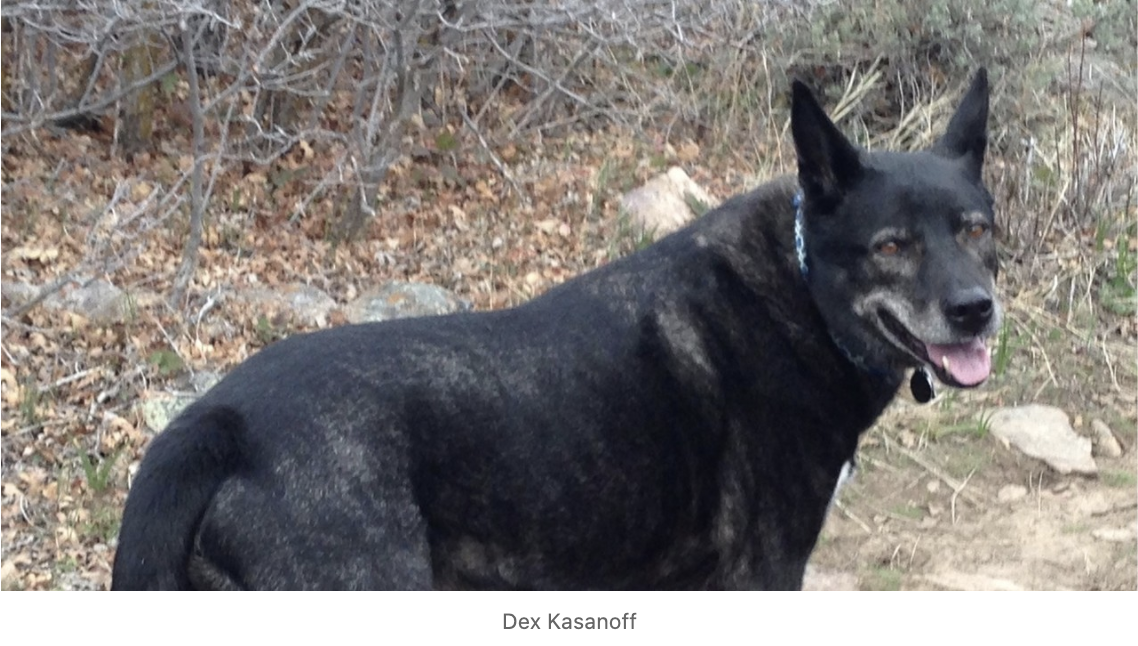
When I first met Dex, we were alone together in a vet's examination room; he had been wandering the streets of Brooklyn, starving almost to death. I was thinking about adopting him, but he was considering a quick escape.

He jumped up against the closed door, so that his head and front paws were just above the door handle. He looked at me. He looked at the handle. He looked at me. He looked at the handle.

That did it. Any dog that calculates whether to open the door or stay with a new human was smart enough for me.

By the way, once home, Dex quickly started opening the door to let himself out into the yard. I wasn't imagining it.

For a few years afterwards, I would find food under my pillow: a loaf of bread, dog biscuits and the like. Dex was hiding food, to be prepared in case he ever ran out again.

And so it went.

This forsaken, emaciated dog never stopped using his head instead of his brawn. He wasn't bitter at being abandoned. He didn't dwell on his unfortunate past. (Many rescue dogs do.)

Dex looked so much like a wolf that my neighbor once threw her body over her toddler to protect the child. I was there, and Dex and I both smiled as she lay on the ground and slowly realized she might have overreacted a bit.

Dex looked dangerous to some, but the only danger was that if your head got low enough, he would lick your face.

There were so many reasons that this creature could have allowed his past to define his future, but that never happened.

I can hear some of you grumbling right now: why do I care... he was a dog... this belongs on FB.

If you pay attention, you can learn a great deal by observing what happens around you. You can learn from dogs, the flow of water, the way ice melts. If you remain curious and open, you can learn; today, I'm sharing what I learned from Dex.

So many humans—and dogs—have a rough start and never escape it. Almost every week, I hear someone talk, more or less, about how their parents' lack of ______ explains why they can't be confident, get promoted, handle intimacy or exhibit compassion.

In fact, I had another dog who lived to be 15 and never escaped the after-effects of abuse that haunted her first two years.

But I'd like to believe that we can choose to leave behind the portions of our history that no longer serve us, if we are willing to work hard enough to accomplish that.

"Hard enough" can be very hard indeed. I'm not downplaying that. It might be brutally difficult.

But it's possible.

Dex Kasanoff passed away this morning at age 16, well-fed and well-loved.

Blade Runner Solves Your AI Problem

by Bruce Kasanoff

Reality check: this is a work of fiction.

"Purpose or money?" Deckard asked Jennifer.

"Excuse me?" she responded nervously. This was going much too fast. The results of this 10-minute session would determine the entire path of her career... and life.

"On which element will you focus your career?" Deckard growled.

"It's either/or? I can't choose both?" she probed.

"No."

"Could you please summarize the essential differences?" she asked, stalling for time.

"Purpose will make you happy and successful on the inside, money will make you appear happy and successful on the outside."

Jennifer blinked. That was a pretty succinct summary. What did she want?

"Which path has the highest potential for a human being with my skills?" she asked.

"Eight minutes and 23 seconds left before we provide you with the default options," said Deckard. "Should I proceed?"

"Yes," she confirmed.

"Career paths for humans are narrowing. Alternative intelligences like me are taking many of the roles humans used to fill. We are tireless, far less prone to errors, and we don't complain. In the 2020's, analysts suggested that empathy was an essential element that humans possessed and AIs didn't, and that jobs that required empathy was a path to successful careers."

"But the Empaths proved that wrong," said Jennifer.

"Yes," said Deckard. "Empaths are far more consistent in displaying empathy than humans, so humans no longer get hired for that skill."

"Is empathy necessary to be successful in a purpose-driven career?" she asked.

"No. Purpose just means you focus on what is meaningful to you, instead of focusing obsessively on accumulating money," said Deckard. "Six minutes and 34 seconds."

"Why are career paths so narrow today?"

"Time has proven the middle approach does not work," said Deckard. "Humans who want it all clog the workforce and cause chaos. They have all been replaced by AIs. They live in the outskirts on Guaranteed Minimum Salaries."

Is it better to look good or feel good, Jennifer asked herself. Do I want outward or inner success? Am I strong enough to know I've succeeded beyond my wildest dreams even if the world looks upon me as a commercial failure?

She looked closely at Deckard, a bio-engineered human. He did not worry about being happy or not. He was not plagued by feelings of inadequacy, and he would not hesitate to pull your eyes out if commanded to do so. She was not confident in her ability to succeed in a no-rules race for money.

"Purpose," she said to Deckard. "I choose purpose."

What would you choose?

Phone Call from Heaven

by Bruce Kasanoff

Reality check: this is a work of fiction.

It’s seldom a good sign when you are 2,000 miles from home and the phone rings in the middle of the night. I grabbed for it, my stomach already clenching.

“Hey Bruce, it’s Lilly.”

Lilly? It takes me a few seconds, but I remember…

Lilly, who started a wine company by walking around San Francisco and inviting restaurant owners to share a glass of her first vintage.

Lilly, who went to Africa to create more sources of clean water… the very same night the thought occurred to her.

Lilly, a friend of a friend, with whom I felt a bond that couldn’t be explained.

That Lilly.

“You busy?”

I smiled. “Lilly, it’s 4 a.m. here.”

“Yeah, I figured you’d have time to talk. Plus, I saw online you were on the road. You know I still read your stuff almost every day. If I have access, of course.”

Still half asleep in the dark, I almost blushed. It had been at least ten years since I’d seen Lilly. I would have guessed she’d forgotten me.

“Can you put on some music?”

“Now? On the call?”

“Yeah, I would, but I don’t have any.”

The thing about Lilly was that she was always making crazy requests, and people would just do them. Earlier in the night, I was listening to The John Butler TrioLive at Red Rocks, so I just started it up again.

“Much better. Nice choice. Hey, Bruce, I gotta tell you something. It’s pretty important.”

She paused for a long time, then continued.

“You’re so very close, Bruce.” She paused again.

“Not sure I follow you, Lilly.”

“You’re a good guy and you’re talented, and you have a great heart, and you work hard.”

A “but” was on its way, no doubt.

“Imagine, just imagine, what you could accomplish if you were always there. I don’t mean for an hour or two at a time. I mean day after day, week after week. How long could you keep it going? Could you spend a month in that state? A year? Maybe two? More? Could you? What would it take?”

Now she was talking in time to the music, tossing out words in spurts.

This wasn’t a completely foreign subject to me, although I rarely discussed it at 4 a.m. “You mean to be present, right?”

“Yeah, present. Completely present. 100%. Present. In the zone. It’s possible you know. You can do it. I’m not just blowing smoke at you. You could stay there for an incredibly, amazingly long time. You’ve got a good, long run in you. I’ve never said this to anyone else, and I just had to tell you. I wish I could have told you…”

Was she crying? She got quiet, and I thought I heard her starting to sob. Then more silence.

“Lilly?”

“We both screwed up. I should have told you sooner, but you should have figured it out long ago. You aim too low, you know? You get a burst of inspiration, it lasts maybe 45 minutes, and you thank the heavens above. That’s trivial. Not even worth mentioning. That’s not a life, it’s a fast food stop. It’s a blip, an afterthought, a pale shadow of your potential. Do you understand your potential? I know you don’t, that’s why I had to call.”

She laughed.

“Hey, Bruce?”

“Yeah?”

“You’re not going to forget what I said.”

“Of course not, Lilly.”

“That wasn’t a question. You’re not going to forget what I said because your phone recorded this entire call. Sorry that I don’t have more time. Truly sorry. So long.”

Huh? I stared at the phone in my hand, then finally put it down and laid back in bed. A few minutes later, I jumped up and pulled out my laptop. I looked up Lilly on Facebook. Nothing. LinkedIn? Nothing. No Twitter either.

Then I found it, a short piece in the Kalamazoo news section on Mlive.com. It was two weeks old.

Lilly Raymond, 47, died in a boating accident on Lake Michigan.

A sense of calm came over me, inexplicably strong. My normal reactions were no longer in play. My brain wasn’t spinning, my stomach wasn’t clenching. I took my time, but there was no doubt in my mind. I swiped down on my phone and searched for Voice Memos, an app I never use. There was one recording there. I pressed Play.

“Hey Bruce, it’s Lilly.”

This video inspired my story, especially Bill Murray’s comments that start at the 3:30 mark.

A Case of Forgotten Identity

by Bruce Kasanoff

Can a human being get to age two without being shaped by their environment? Nope.

Someone tells you…

— when to wake and and go to sleep

— what to eat

— how to dress

— what is “safe” vs. “dangerous”, and “smart” vs. “not smart” (I’m being polite)

— who to play with

— how to feel

Then school comes along and suddenly you have teachers and classmates weighing in. “That’s stupid!” “Don’t be lazy.” “Those guys aren’t cool.”

You might even be told who to hate, and what ideas to fear.

Tests come close behind. They label you, and these labels start to influence your path through life. Some of these labels might originate because you were sick or distracted the day you took an “important” test.

Gaps emerge between who you are and how you are labelled. Some of these gaps are the by-product of a teacher or administrator or even a parent not being wise enough to understand the full complexity and majesty of who you are.

I’m not writing these words to make you feel regretful. What’s done is done. In many cases, I’m sure your true nature emerged despite all these obstacles.

I know that my mother’s well-meaning attempts to make me eat green beans failed because in my soul, I am not a green bean eater.

My point is simple: when we assume that we know who and what we really are, it’s entirely possible that may not be the case.

Getting in touch with the real you is a spectacular use of time and effort, but it can require more time and effort than you expect. From my own experience, I know that even starting down the road of self-discovery often requires a nudge from someone else.

{NUDGE}

You might think: it’s too hard… painful… complicated… challenging… overwhelming.

It’s not.

It’s a gratifying and wonderful journey, as long as you treat it as such.